Also called L-step, Side step, Stepping off the line, Taking an angle
An angle step moves you off your opponent's centre line so you can hit them while their punches point at empty space. It is a short step out to the side, forward or back, followed by a turn to face them again; the L-step, a step back and then to the side, is a common version. Good angles are how skilled boxers stay off the ropes and land counters their opponent can't answer.
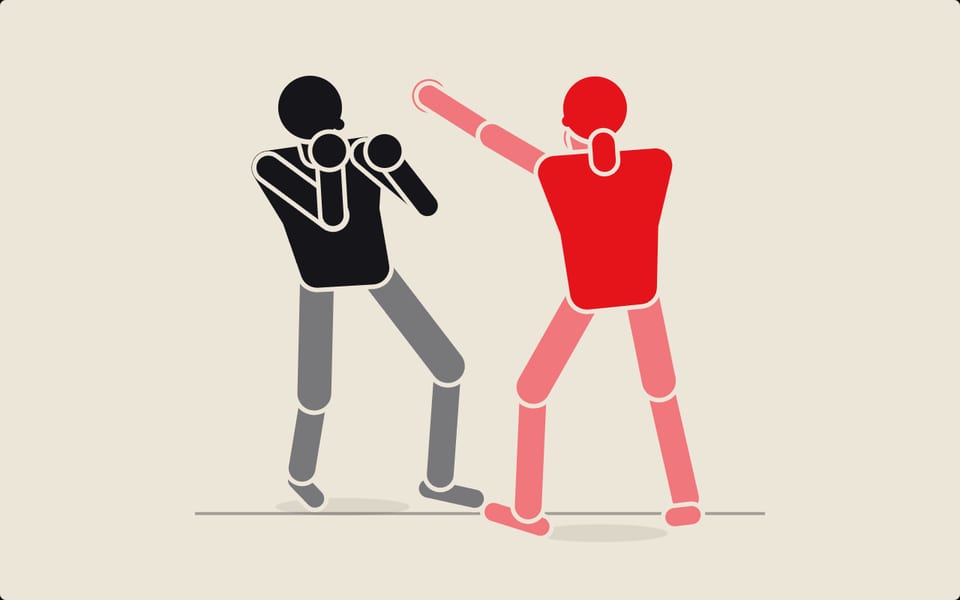
Satori's coaches are filming every technique, full speed and slow motion from two angles. Until it's up, the diagram shows the movement step by step.
How to do it
Start: Your stance at punching range, facing an opponent who is square to you. Know which side you want, usually away from their power hand.
- 1Choose your side, usually away from your opponent's power hand.
- 2Push off the far foot and step the near foot out on a diagonal, a short step off their centre line.
- 3Slide the other foot after it so your stance keeps its width.
- 4Turn your hips and shoulders to face your opponent again from the new angle.
- 5Check that your lead foot is now outside the line of theirs.
- 6Punch right away, while their stance still points where you were.
- Off the line, then face them.
- Small angle, big advantage.
- Step, don't hop.
- Hit from the angle before they turn.
- Hands up during the step.
- Stepping out without punching. Fix: attach a punch to every angle.
- Overstepping. Fix: step just far enough to leave the line, not so far that you leave punching range.
- Crossing your feet. Fix: the foot nearest your direction moves first.
- Not turning back to face them. Fix: finish every angle with your stance pointed at their centre.
- Stepping toward their power hand. Fix: know their strong side and angle away from it.
Safety: Low risk. Practise on a non-slip floor, and keep partner drills at walking pace with light touches until the footwork is automatic.
When to use it
- Against an opponent who charges straight in.
- To get off the line after your own combination.
- To escape toward open space instead of backing straight onto the ropes.
- In open stance, to get your lead foot outside theirs.
- Jab, then angle out as they reach to answer.
- Feint a straight punch to freeze them, then step off the line.
- Slip a straight punch to the outside and step with it.
- A straight rear hand from the new angle
- A hook to the body as they turn
- A pivot if they keep chasing
- Cutting off: an opponent who steps with you takes the angle away.
- A hook thrown to the side you're stepping toward.
- Quick re-squaring: a disciplined opponent turns to face you before you can use the angle.
- Turn with them to face their new position.
- Throw a hook to the side they angle toward.
- Take the centre and cut them off rather than chasing.
The physics
An angle step moves you off the straight line between you and the opponent, so his straight punches point at where you were while you still have a clear line to him.
Step diagonally forward or to the side with the foot on that side first, then bring the other foot to rebuild your stance, so your base stays under you. Straight punches travel along a line; once your head is off it, he must turn his feet and hips before he can hit you with power, and that turn takes time you can use. From the new angle his guard often covers less of his head and body, and your punches can travel straight into the gap. Keep the step short and balanced; a big lunge carries your centre of mass beyond your base and you arrive unable to punch.
Masters and famous moments
Lomachenko controlled the fight from the start with footwork, hand speed and punches from different angles, out-landing Martínez 87 to 34 before a fifth-round knockout. It made him the fastest boxer to win world titles in two divisions.
Lomachenko boxed circles around Sosa and landed from all angles, backing him onto the ropes, until Sosa's trainer threw in the towel after the ninth round.
Across the arts
A step back followed by a step to the side, so the two moves trace an L and you finish angled off the centre line. Coaches differ on which foot moves first; learn your coach's version.
Against an opposite-stance opponent, USA Boxing teaches you to keep your lead foot outside theirs and circle away from their dominant hand.
Some coaches picture the opponent at the centre of a triangle and move along its sides to attack from about 45 degrees.
Angles work the same way, but stepping toward the opponent's rear side can walk you into their power kick.
History
After gloves arrived with the Queensberry Rules, defensive skills such as slipping, countering and angling grew in importance. Coaches have long described angles with shapes on the floor, such as the triangle theory, which places the opponent at the centre of an equilateral triangle. In the modern era Vasiliy Lomachenko became known for his footwork and for punches thrown from uncanny angles. USA Boxing's coaching manual teaches amateurs facing an opposite-stance opponent to set their lead foot outside the opponent's.
Drills
Put a cone or heavy bag in front of you as the opponent. Jab, angle-step to one side, turn to face it and throw a one-two. Alternate sides for three rounds.
A partner walks forward slowly with pads up. Step off the line at the last moment, turn, and tap the pads from the side. Swap each round.
Shadowbox and add an L-step after every second combination, finishing each one with a punch.
Legends known for it








We teach it in Boxing. A coach will fix the details you can't see yourself. Join now and book your first class for $20, paid online.
Related techniques
A pivot turns your whole body around your lead foot, like a door on its hinge. The ball of the lead foot stays planted while the rear foot swings…


Step and slide is boxing's basic way of moving: the foot nearest the direction you want to go steps first, pushed by the other foot, and the other…
A slip moves your head just off the line of a straight punch, so it misses by centimetres while you stay in range to hit back. The movement comes…

Counterpunching means letting the opponent attack first, making the attack miss or land on your guard, and hitting back into the opening it leaves…

Switching stances means changing from orthodox to southpaw, or back, on purpose during a fight. It changes your angles, puts a different hand in…

Cutting off the ring means using sideways footwork to take space away from a moving opponent until their back is on the ropes or in a corner.…