Also called Pivot step, Pivot outside, Pivot inside, Turning the corner
A pivot turns your whole body around your lead foot, like a door on its hinge. The ball of the lead foot stays planted while the rear foot swings around, so you change direction and angle in one quick move. It gets you off the ropes and off the centre line, and lines you up for a counter.
Satori's coaches are filming every technique, full speed and slow motion from two angles. Until it's up, the diagram shows the movement step by step.
How to do it
Start: Your boxing stance at close or mid-range, often just after throwing a punch or when your back is near the ropes. Weight slightly toward the lead foot.
- 1Shift a little more weight onto the ball of your lead foot.
- 2Keep that foot planted and turn on its ball, not its heel.
- 3Swing your rear foot around in an arc, 45 to 90 degrees.
- 4Turn your hips and shoulders with the rear foot so your body moves as one piece.
- 5Keep your hands up and your chin down through the turn.
- 6Finish in your full stance, facing your opponent from the new angle.
- 7Punch or move straight away, before they turn to face you.
- Hinge, not a spin: the lead foot stays put.
- Turn on the ball of the foot, never the heel.
- A quarter turn is plenty.
- Land in your stance, ready to punch.
- Turning on the heel. Fix: stay on the ball of the lead foot.
- Moving the lead foot too, so you just walk in a circle. Fix: the lead foot is the hinge; only the rear foot travels.
- Turning too far and ending square or side-on. Fix: 45 to 90 degrees, then check your stance.
- Pivoting toward the opponent's power hand. Fix: know which way you're turning and why.
- Dropping your hands as you turn. Fix: keep your gloves at your face through the whole turn.
Safety: Pivot on a clean, dry mat in proper shoes; a foot that sticks while your body turns can strain the knee. Build speed slowly.
When to use it
- When your back is near the ropes or a corner and you need to change places.
- When an opponent lunges straight in; a pivot lets them sail past.
- After a lead hook or jab, to take an angle for the next punch.
- Throw a lead hook and pivot with it (the check hook).
- Block or roll their punch on the ropes, then pivot as they lean in.
- Feint one way, then pivot the other.
- A jab or cross from the new angle
- Step and slide into open space
- A lead hook to the body as they turn
- Cutting off the ring: the opponent steps with you, so the pivot leads nowhere.
- A hook timed to your turn, which catches you as you swing toward it.
- Grabbing or leaning on you, which stops the turn.
- Turn with them, re-squaring your stance so they never get a clean angle.
- On the ropes, keep a little distance so they have no room to spin you.
- Throw a hook to the side they're pivoting toward.
The physics
A pivot is a rotation around your lead foot that changes the angle between you and the opponent without giving up ground. Keep your weight on the ball of the lead foot and swing the rear foot around behind you, turning the whole body as one block, so your centre of mass stays over the pivot foot and the stance keeps its shape.
Turning on the ball of the foot, rather than on a flat foot, gives a small contact patch that spins easily and leaves the foot ready to push off. His punches and his momentum were aimed at where you stood, so the pivot takes you off his line while keeping you in range, at an angle where he has to turn before he can punch with power. Pivot with your feet too close together or flat on the floor and the turn becomes slow and unstable.
Masters and famous moments

Mayweather caught the lunging Hatton with a check hook, a lead hook thrown while pivoting away on the lead foot, and Hatton went into the turnbuckle and down. A second knockdown moments later ended it.
Mayweather controlled range with his jab while his movement and pivots made Pacquiao miss; Pacquiao landed only 19 percent of his punches and Mayweather won a unanimous decision.
Pinned on the ropes again in round 7, Leonard got off first and spun Durán so that, for the first time, Durán's back was on the ropes. Durán still won a close unanimous decision.
Across the arts
USA Boxing teaches two versions: the rear foot swings back behind you (pivot outside) or forward in front of you (pivot inside), about 90 degrees each way.
A lead hook thrown as you pivot on the lead foot and swing the rear foot 45 to 90 degrees around, so a lunging opponent sails past like a bull past a matador.
In MMA the same turn is used to get off the cage before an opponent can pin you there.
History
Pivoting is part of basic boxing mechanics: the lead foot turns to power the lead hook and the rear foot turns for the cross. Willie Pep, featherweight champion in the 1940s, was famous for making opponents miss with lateral movement, slips, shoulder rolls and precise pivots. The word is also in the rule books: in 1889 George LaBlanche knocked out 'Nonpareil' Jack Dempsey with a spinning backfist, a blow that was later banned, and amateur rules still list the backhand 'pivot blow' as a foul. Today Terence Crawford's pivoting is often compared with Pernell Whitaker's.
In the rules
Drills
With your lead foot on a mark, pivot a quarter turn swinging the rear foot back, check your stance, then pivot swinging it forward. Do 20 slow reps each way, then add a jab after every pivot.
Back to the ropes, a partner walks in slowly with light touches to your gloves. Block, then pivot so they end up on the ropes. Swap roles every round.
Throw a lead hook on the heavy bag, pivot with it, and land a one-two from the new angle. Three rounds.
Legends known for it


We teach it in Boxing. A coach will fix the details you can't see yourself. Join now and book your first class for $20, paid online.
Related techniques
An angle step moves you off your opponent's centre line so you can hit them while their punches point at empty space. It is a short step out to the…



Step and slide is boxing's basic way of moving: the foot nearest the direction you want to go steps first, pushed by the other foot, and the other…
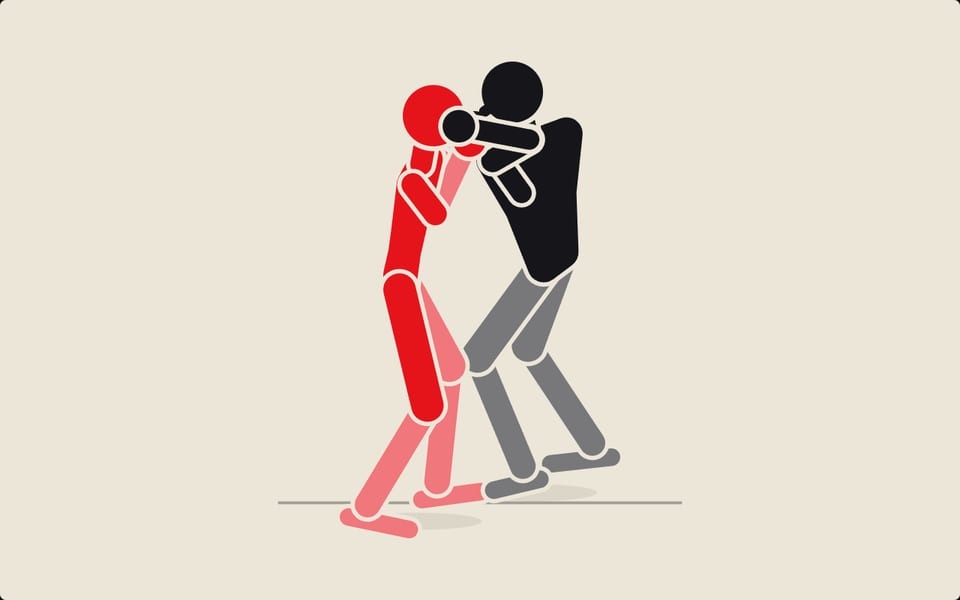
The hook is a bent-arm punch that travels on a short horizontal arc into the side of the jaw or the body. Its power comes from turning the foot,…

Cutting off the ring means using sideways footwork to take space away from a moving opponent until their back is on the ropes or in a corner.…

The rope-a-dope is a tactic, not a single technique: you lean on the ropes behind a tight guard, let a big puncher wear himself out and counter…