並十字絞Nami-juji-jime · say “NAH-mee JOO-jee JEE-meh” · “normal cross-handed strangle (palms down, thumbs inside the collar)”
Judo: 逆十字絞 Gyaku-juji-jime (“reverse cross strangle (palms up, fingers inside the lapels)”) · Judo: 片十字絞 Kata-juji-jime (“half cross-handed strangle (one palm up, one down)”)
Also called Juji-jime, Cross choke, X choke, Cross-handed strangle
The cross collar choke uses your partner's own jacket. You feed both hands deep into their collar with your forearms crossed, then pull your elbows out and down so the edges of your wrists close on both sides of the neck and cut the blood flow to the brain. In judo this is juji-jime, which has three forms named for how the palms face: nami, gyaku and kata. It works from the guard, the mount and the knees, and it is leverage from start to finish, not strength.
Satori's coaches are filming every technique, full speed and slow motion from two angles. Until it's up, the diagram shows the movement step by step.
How to do it
Start: You and your partner are both wearing jackets and their head is close enough for you to reach both sides of the collar. You might be on your back in closed guard, on top in the mount, or kneeling in front of them. The steps below are the common palms-up form from closed guard.
- 1From closed guard, break your partner's posture by pulling their head down with your legs and one hand.
- 2Feed your first hand deep into one side of their collar, four fingers inside and thumb out, as far round the back of the neck as you can reach.
- 3Cross your second hand over or under the first arm and feed it into the other side of the collar, also deep and palm up.
- 4Pull their head toward your chest and keep your elbows close to your ribs so they cannot posture up.
- 5Open your elbows out and down, scissoring your forearms, until the edges of your wrists sit on the sides of the neck.
- 6Squeeze smoothly and keep pulling the elbows toward the floor until they tap.
- 7Let go at the first tap.
- Deep first grip, deeper second.
- Head to your chest.
- Elbows out and down, like scissors.
- Edge of the wrist on the side of the neck, never the front.
- Palms up or palms down: judo names three forms and coaches choose by position.
- Taking shallow grips near the front of the collar, which press the windpipe and waste energy. Fix: grip deep, close to the nape.
- Letting them posture up after the first grip. Fix: break posture before you grip and keep their head on your chest.
- Pulling with the arms instead of opening the elbows. Fix: elbows out and down, pulling with the back.
- Pressing with the knuckles or the front of the wrist. Fix: turn the wrist edge onto the side of the neck.
Safety: A collar choke can put a partner to sleep in seconds, and an unconscious partner cannot tap. Squeeze slowly and smoothly, let go at the first tap, hand slap or limp body, and keep the edge of your wrists on the sides of the neck, not on the windpipe. In judo it is always taught under supervision and closely watched by referees. Learn it from a coach, and stop any partner who shows signs of blacking out.
When to use it
- From closed guard when your partner's posture is broken and their collar is loose.
- From the mount, when they reach up to push you or turn their head.
- After your partner defends an armbar or a kimura and their collar is open.
- In judo ground work, when you are on top of a partner who lies on their back and cannot stop your hands.
- Pull them down with your legs, take the first grip while their hands are busy with your hips or chest, then add the second.
- Threaten an armbar; when they pull an arm back, take the collar with your free hand.
- From mount, walk your knees high and slide a hand into the collar as they raise their arms.
- Fake a sweep to bring their head down, then feed your hands.
- An armbar on the arm they pull away to defend the choke.
- A triangle choke if they post an arm and their head is close.
- A sweep to the top if they posture up hard.
- Posture up and strip the first hand before the second arrives.
- Tuck the chin and get a hand between your neck and their forearm.
- Pull an arm out to escape; the exit is often an armbar, so be ready for it.
- Keep your head up and your posture strong so they cannot bring you down.
- Fight the first collar grip at once with both hands; do not wait for the second.
- Tuck your chin, turn your head away from the crossing arm and tap early.
The physics
The cross-collar choke closes the neck between two forearms like a pair of scissors. Both hands grip deep in your partner's collar with your wrists crossed, so the edge of each wrist and forearm sits over one side of the neck, and pulling your elbows out and toward you turns the pull into an inward squeeze on both carotid arteries.
The deeper the first grip, the closer your wrist starts to the artery and the less slack you must take up before pressure builds. Like other judo strangles, it works on blood flow to the brain, not on the airway. In a lab study of experienced judoka, a juji-jime was held for about 8 seconds on average, and brain-wave slowing could be measured for up to 20 seconds afterwards, without neurological symptoms.
Masters and famous moments
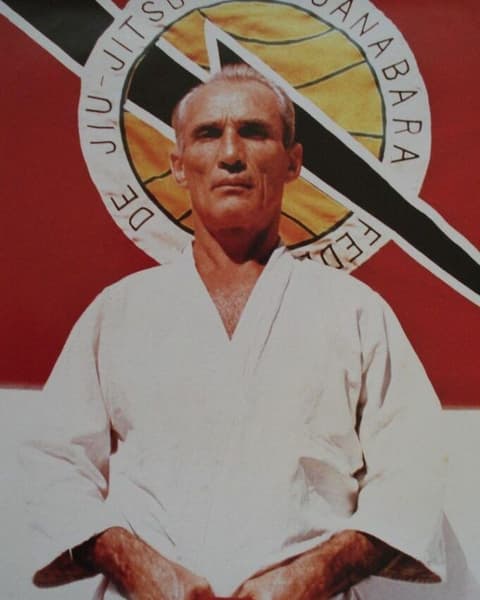
After half an hour, Kato took the fight to the ground and tried a juji-jime; both men became tangled in the ring ropes. Kato paused, expecting the referee to separate them, and Hélio locked in his own choke. Kato lost consciousness and Masahiko Kimura threw in the towel.
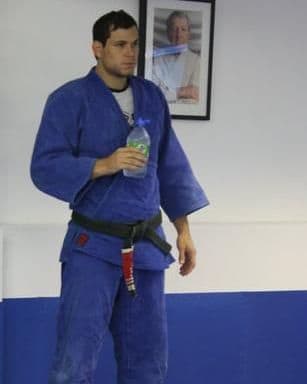
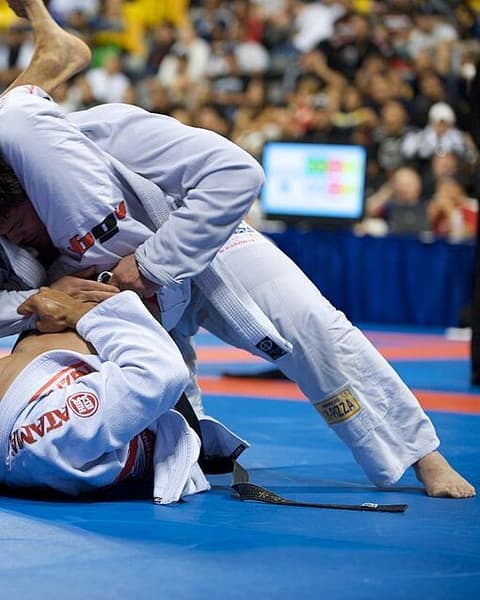
Roger stayed patient on top, passed the guard, worked from side control to the mount and finished with a cross choke.
Across the arts
Both hands cross and grip the collar with the thumbs inside and the palms down. You strangle with the outer edges of your hands on both sides of the neck.
Both hands cross and slip the fingers inside the lapels on both sides, palms up, so the pressure comes on both sides of the neck. Jiu-jitsu players often use palms-up grips like this from the guard.
One hand grips with the fingers inside and the palm up, the other with the thumb inside and the palm down, and you strangle by pulling with one hand and pushing with the other. The paper cutter and baseball bat chokes are among its variants.
History
Juji-jime means 'cross strangle'. The Kodokan lists three forms, nami, gyaku and kata, among its twelve strangles, and two of them, kata-juji-jime and gyaku-juji-jime, are in the Katame-no-kata. The normal form is a fundamental technique in both judo and Brazilian jiu-jitsu. On 29 September 1951 Hélio Gracie beat the judoka Yukio Kato in São Paulo when Kato lost consciousness to Hélio's juji-jime. Roger Gracie later finished the 2009 IBJJF world championship absolute final with a cross choke from mount.
In the rules
Drills
Put a jacket on a heavy bag or dummy. Practise feeding the first hand deep, then the second, in both directions and with palms up and palms down. Twenty slow reps each way, focusing on the depth of the grip.
From closed guard, your partner keeps their posture loose and does not defend. Take both grips and stop before any squeeze. Your partner checks that the cloth sits on the sides of the neck. Ten reps, then switch.
With the grips set, open your elbows slowly to a light squeeze while your partner taps early. Release at the tap, reset and repeat. The aim is to learn the feel, not to finish.
Legends known for it

We teach it in Wrestling & Grappling. A coach will fix the details you can't see yourself. Join now and book your first class for $20, paid online.
Related techniques
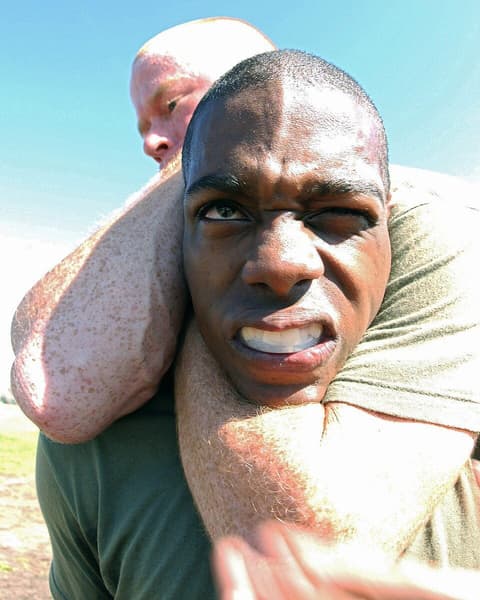
The rear naked choke is a strangle applied from behind. One arm wraps the neck with the crook of the elbow under the chin, that hand grips your…



Okuri-eri-jime is judo's sliding collar strangle. It is applied from behind and uses your partner's own jacket: one hand reaches deep into the far…

The triangle choke traps your partner's head and one of their arms inside a triangle made by your legs. One of your thighs and their own shoulder…

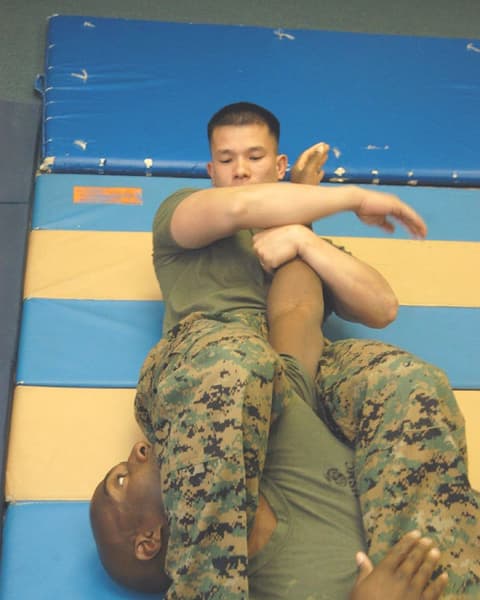
The armbar traps your partner's arm between your thighs, holds their wrist against your chest and lifts your hips so the elbow is forced straight,…



The mount is the top position where you sit astride your partner's torso with a knee on each side. In judo it becomes tate-shiho-gatame when you…

Kumikata is the way you take hold of your partner's jacket. In judo most attacks start here: the grip helps you control your partner and, under the…