送襟絞Okuri-eri-jime · say “oh-KOO-ree EH-ree JEE-meh” · “sliding collar strangle”
Judo: 片羽絞 Kataha-jime (“single-wing strangle, a related jacket strangle from behind”)
Also called Sliding collar strangle, Sliding lapel strangle, Sliding collar choke, Bow and arrow choke (closest jiu-jitsu match)
Okuri-eri-jime is judo's sliding collar strangle. It is applied from behind and uses your partner's own jacket: one hand reaches deep into the far collar, the other passes under the armpit to take the opposite lapel, and pulling the two across the neck squeezes both sides at once. It is one of the twelve official strangles in the Kodokan list, and the closest jiu-jitsu match is the bow and arrow choke.
Satori's coaches are filming every technique, full speed and slow motion from two angles. Until it's up, the diagram shows the movement step by step.
How to do it
Start: You are behind your partner with your chest on their back, and both of you are wearing jackets. You might be on the mat with your legs around their waist, or kneeling behind a partner who has gone down on their hands and knees.
- 1Get behind your partner with your chest on their back and your legs or knees controlling their hips.
- 2Reach one hand around the front of their neck and grip the far collar deep, close to the back of the neck.
- 3Slide your other arm under their armpit on that same side, across their chest, and grip the opposite lapel low.
- 4Put your head beside theirs and settle your chest into their back.
- 5Pull the deep collar back and across toward your shoulder while the low hand pulls the lapel down and across, so the cloth closes on both sides of the neck.
- 6Keep your elbows in and squeeze smoothly, using your back and your chest, not just your hands.
- 7Release the instant they tap or go limp.
- Deep first grip, close to the nape.
- Low lapel, pull down and across.
- Chest on the back, head beside theirs.
- Cloth on the sides of the neck, never fingers on the throat.
- Pull with your back and squeeze smoothly.
- Taking a shallow first grip, so there is no cloth to tighten. Fix: reach deep, close to the back of the neck.
- Pulling with the arms alone. Fix: settle your chest on their back and pull with your whole body.
- Letting the cloth ride across the front of the throat. Fix: keep the pressure on the sides of the neck.
- Dropping your control of the hips. Fix: keep your legs or knees active so they cannot turn out.
Safety: Jacket strangles close the blood supply quickly, and an unconscious partner cannot tap. Squeeze smoothly, never jerk, and let go at the first tap or the moment your partner goes limp. Keep the cloth on the sides of the neck, not on the windpipe. At the 1964 Olympics a French judoka went limp in this strangle without tapping and the referee did not notice at first; your partner may do the same, so watch for a sudden stillness. Learn this hold only with a coach who knows how to handle a blackout.
When to use it
- When you take the back in ne-waza from a turtle, a scramble or a failed throw by your partner.
- When your partner tucks their chin against a bare-arm choke: the jacket gives you a grip that is hard to strip.
- When you are already behind and have time to set both grips.
- As a finish in jacket sports when the referee allows ground work to continue.
- From a turtle, hook the far collar with your first hand, then feed the second arm.
- As you take the back, keep your lapel grip from the standing exchange and pull it across.
- From back control, use the choke threat to make your partner move their hands, then change to an armlock.
- After a throw attempt that turns your partner away from you.
- Hadaka-jime if they strip the collar or you lose the grip.
- Kataha-jime (the single-wing strangle), which uses the same jacket from behind.
- An armlock on the arm that fights the choke.
- Tuck the chin and peel the deep collar hand with both hands before the second grip arrives.
- Turn into the attacker and free your hips toward guard.
- Clear the hooks and slide out the back door as the pressure begins.
- Tuck your chin the moment they take your back and keep both hands on your own collar.
- Fight the first, deep grip before the second hand arrives, and turn your shoulders.
- Tap early: a jacket strangle works fast and you cannot tap once you are out.
The physics
Okuri-eri-jime uses the jacket as the tool. From behind, one hand reaches deep into your partner's far collar and draws the lapel across the neck while the other hand pulls the near lapel down, so the collar tightens around the neck like a noose closing from both sides.
The lapel's thin edge concentrates the pull on a small area, and because pressure is force divided by area, a modest pull is enough to squeeze the carotid arteries on the sides of the neck. It is a blood strangle, not an air choke, and a properly applied judo strangle has been reported to cause unconsciousness in 10 to 20 seconds. Pulling your chest into their back tightens the loop smoothly without jerking. The danger lies in holding on too long: in World Championship video, athletes kept in a strangle for 4 seconds or more after going out were much more likely to convulse or stagger on waking.
- Myth: holding a strangle a moment longer to make sure is harmless. At World Championships, athletes still held 4 seconds or more after going unconscious were much more likely to convulse or stagger on waking; release the instant your partner taps or goes limp (Sasaki et al. 2022).
Masters and famous moments
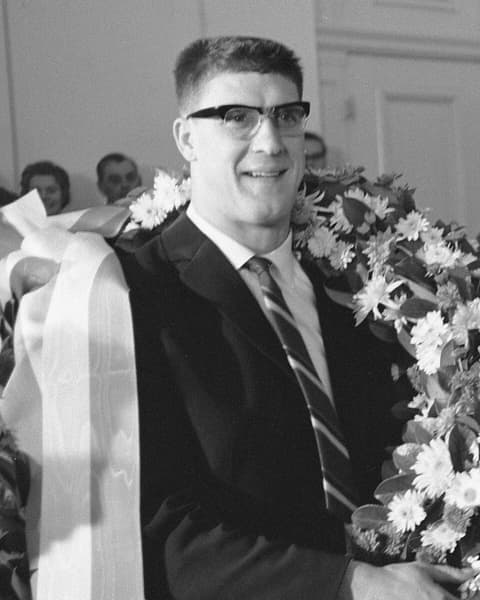
After being reversed onto his back, Okano caught Grossain in a collar strangle and suddenly realized Grossain had stopped fighting. The referee did not see that Grossain was unconscious until a Japanese coach pointed out his limp legs; Okano then revived him with katsu, and Olympedia reports no injury. Okano went on to win the gold medal.

Yamashita beat Schnabel by ippon at 2:50 with a strangle recorded as okuri-eri-jime. He tore his right calf in this match and limped through the rest of the tournament, which he still won.
Taimazova, who was fighting with a badly swollen eye, resisted for more than 16 minutes. Arai finally won by ippon with okuri-eri-jime at 16:41, and Taimazova passed out on the mat without tapping.
Across the arts
This is the closest jiu-jitsu equivalent. It is a choke from the back that uses the collar, and it is described as the most frequent choke in 21st-century judo.
From behind, reach one arm around the neck to grip the far lapel, then slip the other hand under the armpit and round the back of the neck and strangle by pulling with one hand and pushing with the other.
Judo books list forms such as yoko-jime and tawara-jime. Kyuzo Mifune demonstrated tawara-jime in The Essence of Judo and describes it in The Canon of Judo.
History
Okuri-eri-jime, the 'sliding collar strangle', is one of the twelve strangles on the Kodokan list and one of the five in the Katame-no-kata. It is described in Kyuzo Mifune's The Canon of Judo. At the 1964 Tokyo Olympics, the first Games with judo, Isao Okano won a quarter-final with it on his way to the middleweight gold. The bow and arrow version has become the most frequent choke in modern judo. Chizuru Arai used it in a Tokyo 2020 semi-final that lasted more than 16 minutes.
In the rules
Drills
Put a jacket on a heavy bag. From behind it, practise the two grips: the deep collar and the low opposite lapel. Twenty reps on each side, slowly, then hold each finished position for three seconds.
Your partner is on their hands and knees in a jacket. Take both grips and stop before any pressure. Your partner checks that the collar sits on the sides of the neck. Switch after ten reps.
From the back, apply the strangle slowly to a light squeeze while your partner taps early. Reset and repeat. The aim is to learn the feel of the pressure, not to finish.
Legends known for it

We teach it in Throws. A coach will fix the details you can't see yourself. Join now and book your first class for $20, paid online.
Related techniques
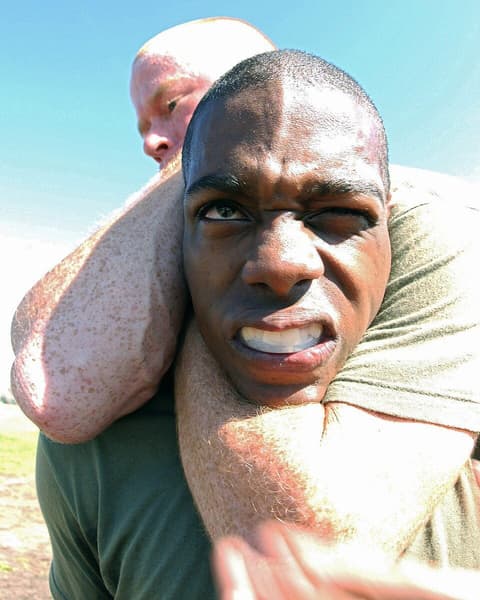
The rear naked choke is a strangle applied from behind. One arm wraps the neck with the crook of the elbow under the chin, that hand grips your…



The cross collar choke uses your partner's own jacket. You feed both hands deep into their collar with your forearms crossed, then pull your elbows…
The triangle choke traps your partner's head and one of their arms inside a triangle made by your legs. One of your thighs and their own shoulder…

Kesa-gatame is judo's classic side pin. You sit beside your partner's chest, trap their near arm, wrap your other arm around their head and press…

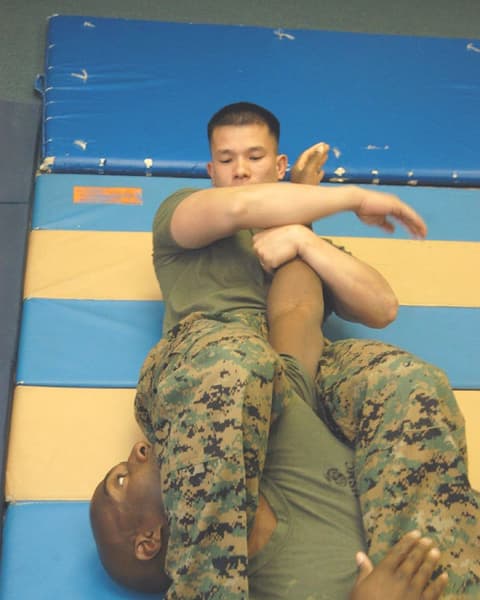
The armbar traps your partner's arm between your thighs, holds their wrist against your chest and lifts your hips so the elbow is forced straight,…



Kumikata is the way you take hold of your partner's jacket. In judo most attacks start here: the grip helps you control your partner and, under the…