受身Ukemi · say “oo-KEH-mee” · “receiving body: the art of taking a fall or a technique safely”
Judo: 後ろ受身 Ushiro-ukemi (“rear breakfall”) · Judo: 横受身 Yoko-ukemi (“side breakfall”) · Judo: 前受身 Mae-ukemi (“forward breakfall”)
Also called Breakfalls, Falling techniques, Safe falling
Ukemi is the art of falling safely. Judo teaches four breakfalls (rear, side, forward and the forward roll) that spread the impact over your arm, back and side and keep your head off the mat. Judo Canada says a judoka should have at least a basic command of falls before learning throws and sparring.
Satori's coaches are filming every technique, full speed and slow motion from two angles. Until it's up, the diagram shows the movement step by step.
How to do it
Start: You start on a mat with a qualified coach nearby, lying on your back. As each stage feels safe you move to sitting, then crouching, then standing. You do not need a partner at first. The steps below teach the rear breakfall, because judoka are generally thrown onto their backs.
- 1Lie on your back with your chin tucked to your chest, your eyes on your belt and your arms crossed over your chest.
- 2Strike the mat with both arms at the same time: palms down, fingers together, the whole arm at about 45 degrees from your body. Let your hands bounce back to your chest.
- 3Sit up with your arms crossed, roll back onto your hips, then stretch your legs up and forward, straight and not crossed, and strike as you roll onto your shoulders.
- 4Do the same roll from a crouch, sitting down as close to your heels as you can.
- 5Do it again from standing: crouch first, then roll back and strike.
- 6On every rep, keep your back round, your knees over your stomach and your head off the mat.
- 7Add movement: step back into a crouch and roll, or walk forward, turn and roll.
- 8When your coach agrees, take a gentle o-uchi-gari from a partner and fall the same way.
- Chin on your chest, eyes on your belt.
- Strike with the whole arm, palm down, fingers together, at about 45 degrees (Judo Canada allows 35 to 55).
- Round back, knees over your stomach.
- Legs straight and wide, never crossed.
- Loose while you fall, firm at the instant of impact.
- Letting your head touch the mat. Fix: chin on your chest and eyes on your belt for the whole fall.
- Slapping with your arm too close to your body or too wide. Fix: aim for about 45 degrees. Judo Canada warns that a smaller angle risks rolling over the arm and injuring it, and a larger one crushes your whole back.
- Crossing your legs as you land. Fix: swing them straight and wide, so you do not strike your ankle or heel.
- Reaching a hand out to catch yourself. Fix: let the roll and the whole-arm strike take the impact; the reflex to put a hand down can injure your fingers, wrist, elbow or shoulder.
- Staying stiff from start to finish. Fix: keep your joints loose so they absorb the shock, and firm up only at the instant of impact.
Safety: Learn ukemi from a qualified coach, on mats, after your warm-up, and practise it every session. Judo Canada asks for a basic command of falls before any throwing or sparring. Keep your chin tucked so your head never touches the mat, strike with the flat palm and the whole arm, keep your legs uncrossed, and do not reach a hand out to catch yourself: that reflex can injure your fingers, wrist, elbow and shoulder. Build up from lying to sitting, crouching and standing before you are thrown. Tired athletes fall worse: one study in a 2022 review found breakfall skill dropped with fatigue, so take extra care late in a hard class.
When to use it
- Every time a throw, sweep or takedown puts you on the mat.
- At the start of every class: Judo Canada says falls are practised every session, even by advanced students.
- Whenever you are uke in throwing practice, taking the throw in repetition (uchikomi) or controlled (yakusoku) drills.
- When you slip or trip away from the mat: the International Sambo Federation runs a safe-falling program in schools for exactly that.
- Start lying down, to learn the landing position.
- Move on to sitting, crouching and standing.
- Add movement, then props: sit on a gym ball and roll back, or step backward into a stick that two partners hold at knee height.
- Finish with a partner: a gentle o-uchi-gari for beginners, o-soto-gari for the more advanced.
- In training, stay in the landing position for a moment before you get up.
- String falls together: roll, stand, back fall, side fall, then roll up, as in Judo Canada's falling games.
- Move on to throwing practice and sparring once your falls are secure.
The physics
A breakfall spreads an impact over more area and more time. When you are thrown, your body arrives with momentum, and the average force of the landing equals that momentum divided by the time it takes to stop, so landing in sequence (arm, then shoulder, back and hips) or rolling lengthens the stop and lowers the force.
The energy of the fall is also absorbed over a longer distance, and because pressure is force divided by area, meeting the mat with the whole arm and the broad back rather than an elbow, hip point or head lowers the load on any one spot. In lab tests on elite judoka, the more body surface that met the mat and the longer the contact lasted, the more gently the head slowed, and whole-arm contact was strongly linked to that slowing. Tucking the chin keeps the head off the mat, which matters because head strikes in backward throws produce the rotational acceleration linked to bleeding on the brain. Martial-arts side falls also land more slowly and with a flatter trunk, which cut hip impact force by 27 to 30% in one study.
- Myth: the slap does all the work. In side falls, martial-arts technique cut hip impact force by 30% even without using the arm; the gains came from a slower, flatter landing and rolling. The arm still helps protect the head: in backward falls, whole-arm contact was strongly linked to a gentler slowing of the head (Groen et al. 2007; Hashimoto et al. 2015).
- Myth: putting a hand out stops a throw safely. In a nationwide study of Japanese adolescent judo, elbow injuries often happened when players straightened an arm to avoid being thrown, especially against seoi-nage (Ikumi et al. 2024).
Masters and famous moments
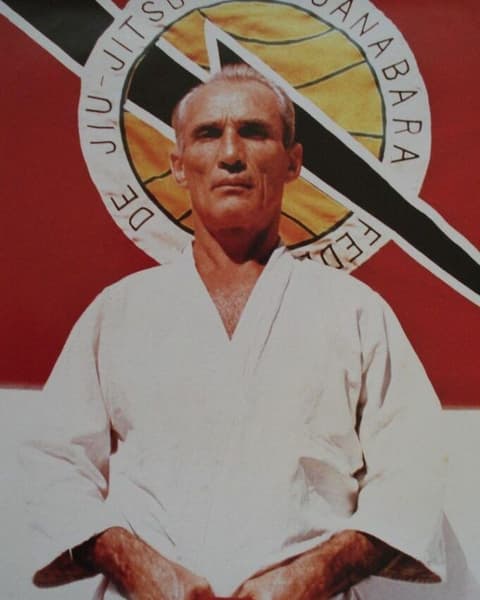
Kato controlled the match with his throwing, but the mats were too soft for his throws to be decisive, and Hélio took ukemi until time ran out. The match was a draw.
Kimura scored with ouchi-gari, harai-goshi, uchi-mata and ippon-seoi-nage, but Gracie could take ukemi safely on the soft mat, so throws alone could not finish him. Kimura later wrote that the soft mat forced him to drop his plan of knocking Gracie out. He won in round two with the armlock now named after him.
Across the arts
You fall backward with a round back and your chin tucked, and strike with both arms. Judo Canada asks for extra attention here, because backward falls build the muscles that support the head.
You swing one leg out to the opposite side to tip yourself off balance, sit down beside the heel of your supporting leg, roll over your shoulder blade and flank and strike with the arm on the side you land on. Your other hand stays by your belt and your legs fold down without crossing.
You fall forward onto your hands and forearms, with your arms bent like springs, your fingers turned inward and your back leg extended. The IJF and Kodokan classification calls it unrealistic, because judoka are generally thrown powerfully onto their backs; Judo Canada still teaches it.
You roll forward over the shoulder on the side of your leading foot, along a strip from that shoulder across your back to the opposite hip, and strike with your free hand. Look back through the gap between your body and arm, and keep your back leg extended as you land. Judo Canada calls it zempo-kaiten-ukemi.
Sambo calls safe falling samostrakhovka, Russian for self-insurance. The International Sambo Federation (FIAS) calls safe falling a compulsory fundamental element of sambo, and Rudman's sambo textbook says children's schools do not let you start on techniques until you pass a self-insurance test. Its back fall has the same shape as judo's (round back, chin on chest, arms at 45 degrees, palms down), and it forbids putting out the arms or elbows, or going to a wrestling bridge. A Russian sambo coaching site adds that the thrower has a matching duty, strakhovka: in throws where the thrower stays on their feet, they soften the partner's fall by holding the clothing or guiding the partner into a roll.
History
Ukemi means 'receiving body', and many judo and aikido classes begin with it as conditioning. The IJF and Kodokan list four breakfalls: rear, side, forward and forward rolling. The IJF rule book says Jigoro Kano built judo so that techniques could be applied fully without ever injuring the opponent, and that ippon was granted only if the fall was controlled until the thrown person hit the ground. A 2022 systematic review of 16 studies of adult judoka concluded that ukemi is essential in preventing head and neck injuries. Sambo has its own version, samostrakhovka, which FIAS has built into a school safe-falling program. In 1951 ukemi was on show in two famous matches in Brazil, where Hélio Gracie took breakfalls on soft mats through Yukio Kato's throws (a draw) and through Masahiko Kimura's throws in round one.
In the rules
Drills
Lie on your back with your chin tucked and your eyes on your belt. Strike with both arms at about 45 degrees, palms down, then let your hands bounce back to crossed on your chest. Do sets of ten.
Sit low on your heels with your free hand on your belt. Swing one leg out to the side opposite the way you will fall, to tip yourself off balance. Drop onto your side and strike with the arm on that side. Land on your side, not your back. Ten reps each way.
Your partner gets on all fours. Sit on their back, then let yourself slide backward until you have to fall. Tuck your chin and strike as you land. Ten reps, then swap.
We teach it in Throws. A coach will fix the details you can't see yourself. Join now and book your first class for $20, paid online.
Related techniques
Kuzushi is breaking your partner's balance so they cannot resist your throw. In judo it is the first of three parts of every throw: kuzushi (break…
Kumikata is the way you take hold of your partner's jacket. In judo most attacks start here: the grip helps you control your partner and, under the…
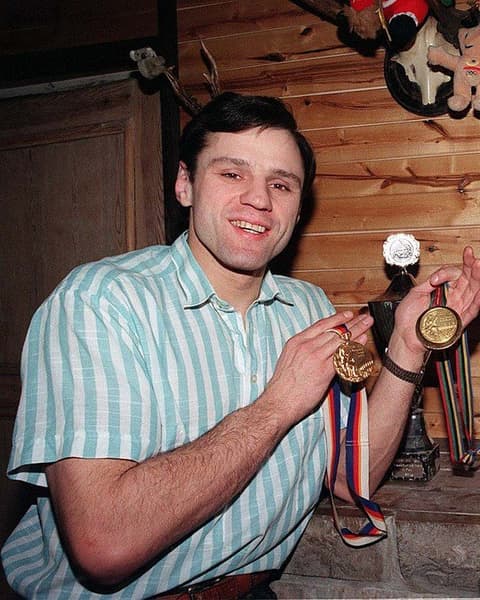
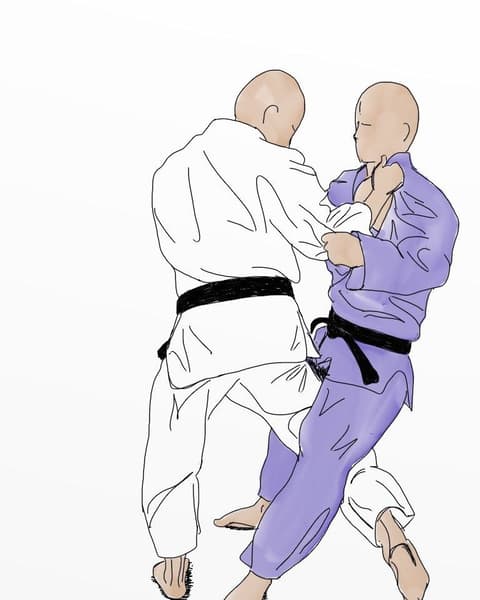
Ouchi-gari is the 'major inner reap'. You step in chest to chest, hook your leg around the inside of one of your partner's legs and sweep it out…



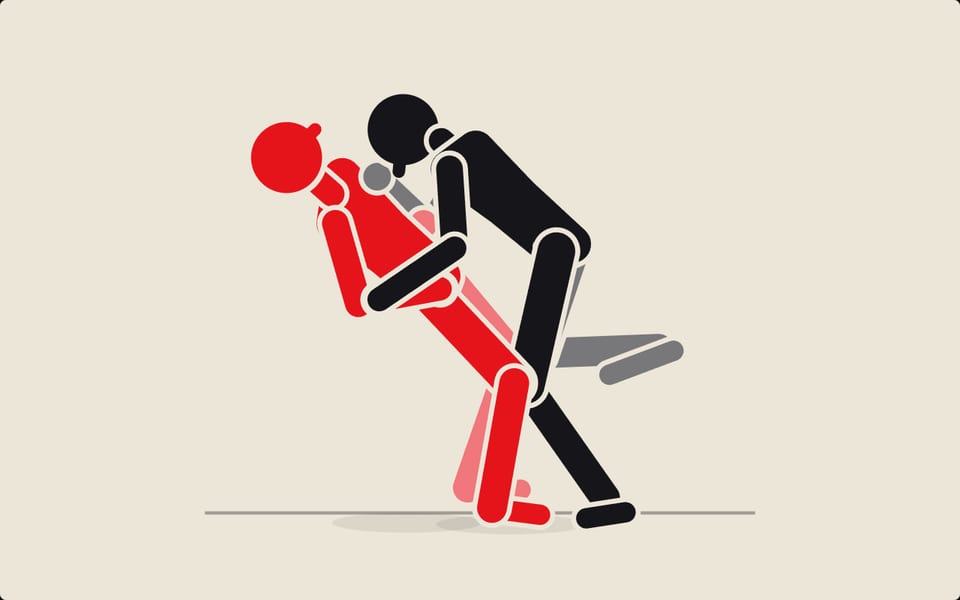
Osoto-gari is the 'major outer reap'. You break your partner's balance back onto one heel, step deep beside that leg and reap it away from behind…
De-ashi-barai is the 'advancing foot sweep'. You wait for your partner to take a step, then sweep that foot along its path at the instant their…
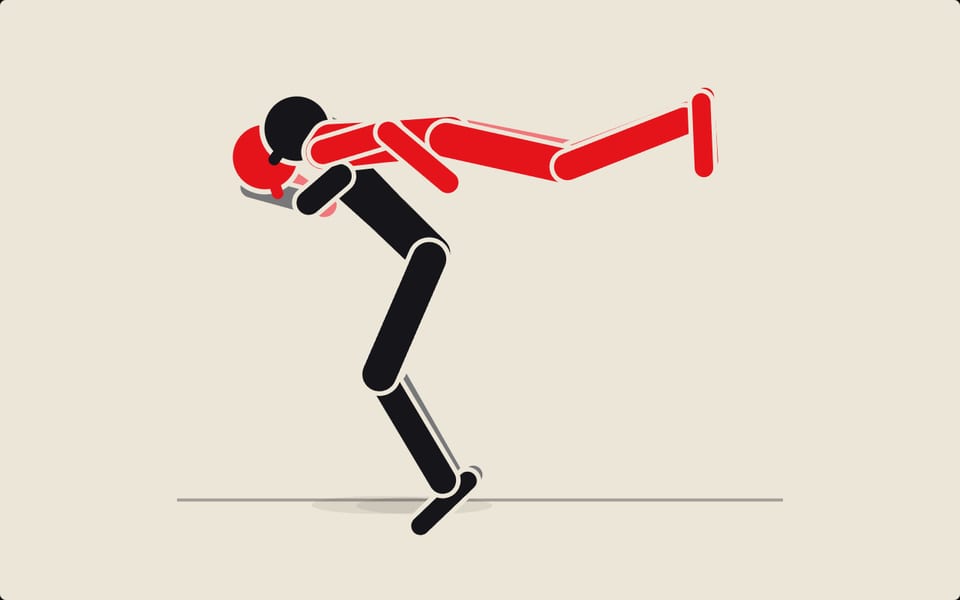
Seoi-nage is judo's shoulder throw. You turn your back into your partner, tuck an arm under theirs, load them onto your back and tip them forward…
 1985–2000