体落Tai-otoshi · say “TIE oh-TOH-shee” · “body drop”
Also called Body drop
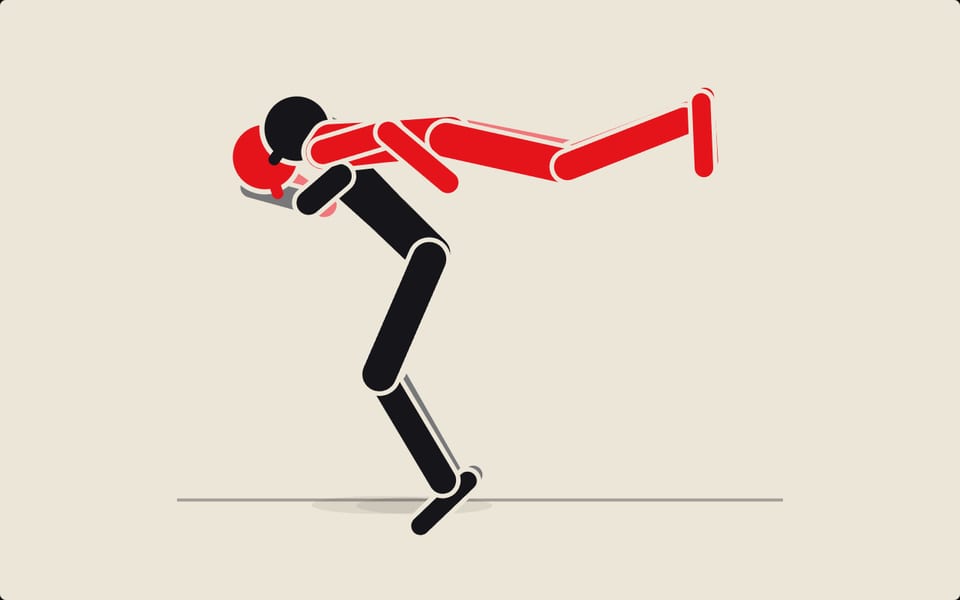
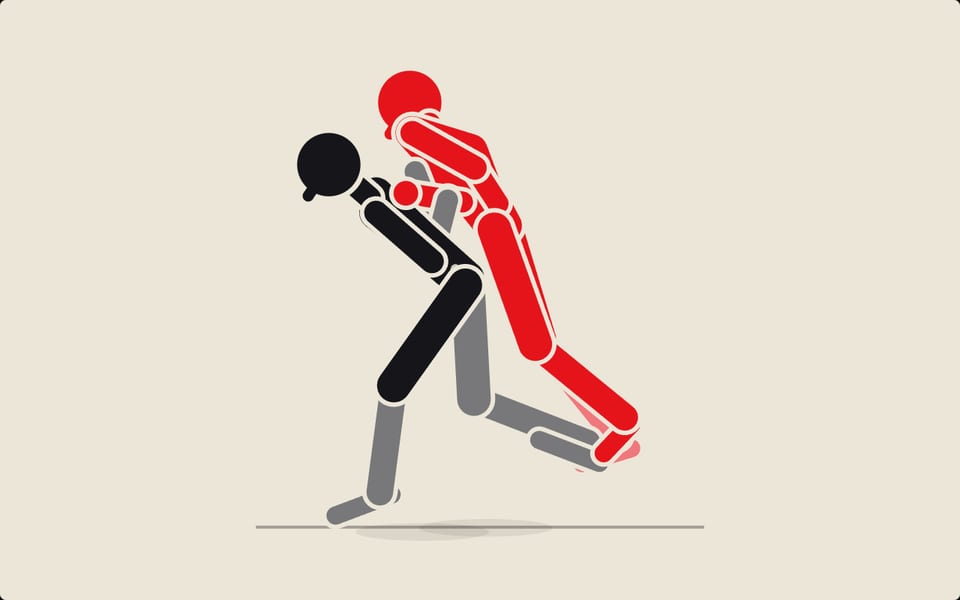
Tai-otoshi is judo's body drop. You turn away from your partner, stretch one leg across the front of their foot as a barrier, and pull them forward over it. It is a hand throw: your hips and back stay clear of their body, and your hands and the blocking leg do the work. It runs on timing, because the best moment is when your partner has just stepped back and their weight is about to return.
Satori's coaches are filming every technique, full speed and slow motion from two angles. Until it's up, the diagram shows the movement step by step.
How to do it
Start: Take the classic right-handed grip: left hand on their right sleeve, right hand on their left lapel. Stand about an arm's length apart in a natural stance. You want your partner standing tall and stepping their right foot back, for example after you have pulled them forward and then eased off.
- 1Grip. Hold the sleeve with your left hand and the lapel with your right, elbows soft.
- 2Kuzushi. Step back pulling them forward, stop and press down lightly. When they straighten and start to step back with their right foot, ease the pull and give a small push with your left hand. As that right foot passes behind the left, lift with your right hand and pull up with your left. They rise onto their toes and can't put weight on the right foot.
- 3Tsukuri, first foot. Step your right foot in between their feet and pivot on it, turning to the left.
- 4Tsukuri, second foot. Step your left foot back and round so you stand side-on to them. Bend the left knee, lower your hips and stretch your right leg across the front of their right ankle, crossing it lightly. Your legs are wide apart, your chest is out, and your back and hips stay off their body.
- 5Kake, pull. Lift with your right hand and pull down with your left, putting strength from your hands, hips and legs behind it.
- 6Kake, turn. Keep the right leg straight and their foot blocked as you turn your upper body to the left. Pull them forward in the direction their right toes point. They fall in a large circle around their right toe.
- 7Finish. Hold the sleeve through the landing and stay on your feet, then control them or move into a hold.
- Cross their foot lightly. You are blocking it, not kicking it.
- Hips and back stay away from them. The hands do the work.
- Pull along the line their toes point, not round to the left.
- Lift first, then pull down.
- Stepping in so close that your hips touch them. Fix: keep your back and hips clear. Once you touch, they can push your hips and stop the throw.
- Pulling them round to your left instead of along the line of their toes. Fix: pull forward so they pivot on their right toe.
- Acting too late, so their weight settles on the right foot. Fix: move the moment their right foot passes behind the left.
- Standing tall with a straight back. Fix: bend the left knee, lower your hips and stretch the right leg into the block.
- Dropping down on top of them or diving to the mat. Fix: stay on your feet. Head diving is a hansoku-make.
Safety: Practise on mats with a partner who can breakfall. Hold the sleeve so they land on their back, and never drop onto them or dive head-first.
When to use it
- The moment they step back with the right foot. This is the Kodokan's own timing.
- As a counter to their uchi-mata. Step back out of it and throw them over your leg as they lurch forward.
- After a feint of o-uchi-gari makes them step back to keep their posture.
- Feint o-uchi-gari with your right foot so they step back, then cross their foot.
- Push lightly, then pull, so their weight comes forward on the rebound.
- Two-motion version: swing their left leg lightly outward with your right foot to break their balance, then step across. The Kodokan stresses that this is not a combination from o-uchi-gari.
- A hold-down such as kesa-gatame. After a real attack that doesn't score, the IJF rules let you go straight to the ground.
- Seoi-nage if they bend forward but stay on their feet. Both throws come from the same forward break of balance.
- Ura-nage. Anton Geesink caught Akio Kaminaga's tai-otoshi attempt with it in the 1964 Olympic open final, then held him down for ippon.
- Twist your left foot round to the rear as they pull you round to their left. The Kodokan notes that this defeats the throw.
- Settle your weight onto the right foot as soon as it lands. The Kodokan notes that if the thrower is too slow, your weight is already there and the balance can't be broken.
- Keep your posture upright and firm. The Kodokan says tai-otoshi is hard to do against a rigid posture.
- Lower your hips and keep your chest up so they can't pull you forward.
- Pull your sleeve free and turn to face them as they step across.
The physics
Tai-otoshi is a lever with the longest possible arm. Your extended leg blocks your partner's shin just above the ankle, putting the fulcrum almost at floor level, while your hands and turning trunk pull their upper body forward and around that stop.
With the pivot at the ankle and your hands near the shoulders, the lever arm is nearly their full height, so Sacripanti places it among the maximum-arm levers, which need the least force of any lever throw. He shows tai-otoshi, ashi-guruma and o-guruma as the same entry with the block moved up from the ankle to the knee to the belly, each step shorter in lever and more costly in energy. The leg is a stop, not a sweep: if it kicks or lifts, the fulcrum moves and the lever collapses. The long radius also makes the upper body travel fast, and in one video study the thrown player's shoulder reached a higher peak speed than in morote-seoi-nage.
- Myth: tai-otoshi is a trip or a leg sweep. Your leg is only the stop; the throw comes from your hands and turning trunk rotating the partner over it, like a lever over its fulcrum (Sacripanti 1987).
Masters and famous moments
Inokuma knew that Kiknadze, a Soviet sambo fighter, had nearly beaten him in 1961 with armlocks. He took no chances: around the five-minute mark he threw Kiknadze with tai-otoshi and moved on to the final against Canada's Doug Rogers.
Both players had picked up penalties and nothing had scored. Lima broke the deadlock 2:20 into golden score with a tai-otoshi for ippon, which sent him into the Olympic final against Hifumi Abe.
Japan's hope in the open class beat Germany's Glahn with tai-otoshi in 4:10. In the final he tried the same throw on Geesink, who countered it.
Across the arts
The form in the steps above, which the Kodokan describes as the most common one.
Your right fingers go inside their collar and your left hand holds the sleeve. You push up against their chest, then pull down and throw. The Kodokan stresses there is no body contact, which separates it from kata-eri-seoi, where your elbow goes under their armpit.
You cross their arms during a grip fight and throw with your shoulder against their elbow. The Kodokan says it is rarely used in competition.
Dodge their uchi-mata by stepping back, then throw them over your leg as they fall forward. The Kodokan and the IJF list this as a separate throw.
It is thrown on the move, often as a timing throw. Willian Lima's golden-score ippon at the Paris Olympics and Tato Grigalashvili's waza-ari in round two of the 2024 Worlds show that it still scores at the top level. The mechanics don't change: cross step, stretched leg, clear hips, hands pull down.
History
Tai-otoshi is one of the original forty throws of Jigoro Kano's Gokyo and sits in its second group. The Kodokan treats it as a hand throw without hip contact, which is what separates it from the hip throws and from seoi-nage. At Tokyo 1964, the first Olympics with judo, Isao Inokuma and Akio Kaminaga both won semi-finals with it, and Geesink later countered Kaminaga's attempt in the open-category final.
In the rules
Drills
Practise the footwork alone along a line on the mat: right foot across, left foot back, right leg stretched, hands pulling down. Ten slow reps each side, then ten quick ones.
Your partner steps back with their right foot as you pull and ease. Fit in and hold the block for a count of two. Ten reps each side.
Throw at half speed onto mats with a trained partner, five reps each side, holding the sleeve through the landing.
We teach it in Throws. A coach will fix the details you can't see yourself. Join now and book your first class for $20, paid online.
Related techniques
Seoi-nage is judo's shoulder throw. You turn your back into your partner, tuck an arm under theirs, load them onto your back and tip them forward…
 1985–2000
Uchi-mata is judo's inner thigh throw. You open your partner's feet, break their balance forward, turn in and swing your leg up between theirs,…



Kata-guruma is judo's shoulder wheel. You get under your partner, load their upper body across your shoulders and roll them over like a wheel. The…
Ouchi-gari is the 'major inner reap'. You step in chest to chest, hook your leg around the inside of one of your partner's legs and sweep it out…

Ura-nage is judo's back throw. You wrap both arms round your partner from the side, lift them off the mat and fall backward, throwing them in a…
Kuzushi is breaking your partner's balance so they cannot resist your throw. In judo it is the first of three parts of every throw: kuzushi (break…