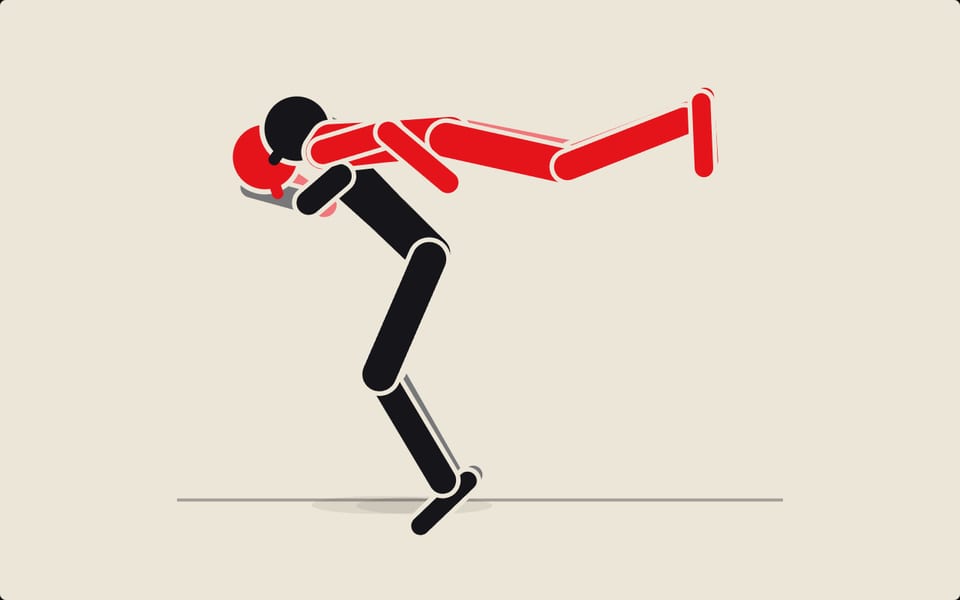
肩車Kata-guruma · say “KAH-tah goo-ROO-mah” · “shoulder wheel”
Also called Shoulder wheel
Kata-guruma is judo's shoulder wheel. You get under your partner, load their upper body across your shoulders and roll them over like a wheel. The classic Kodokan form holds the partner's thigh, but the IJF forbids touching the legs from the top of the inner thigh down. In competition today the throw is done with jacket grips only, and it is still winning big titles.
Satori's coaches are filming every technique, full speed and slow motion from two angles. Until it's up, the diagram shows the movement step by step.
How to do it
Start: Take a right-handed grip: left hand on their right sleeve, right hand on their lapel or collar. Keep your hips back so your chest doesn't jam into theirs. Your partner should be upright or starting to bend forward. The steps below are the jacket-grip version used under IJF rules. The classic form with the thigh hold is described under Variations.
- 1Grip. Start with sleeve and lapel. Many coaches teach a version that traps one arm: both hands on their sleeve, then the inside hand moves to the lapel on the same side. Keep your hands above the top of their inner thigh.
- 2Kuzushi. Step back and pull the sleeve up and across your chest, so they fold forward onto their toes, straight ahead or toward their right front corner.
- 3Tsukuri, feet. Step your right foot in between theirs, bend both knees and drop your hips, turning your chest toward them.
- 4Tsukuri, shoulders. Put your right shoulder against their right front hip and the back of your neck against the front of their belt, so their upper body folds across your shoulders.
- 5Tsukuri, load. Keep pulling the sleeve into your chest. Raise your head, straighten your back and push your chest out. Lift with your legs, never by bending at the waist. Their weight now rides across both shoulders.
- 6Kake. Keep pulling the sleeve down toward your left hip as you drive up and turn. They roll over your shoulders like a wheel and land to your left front.
- 7Finish. Stay upright, or kneel beside them, with the sleeve still in your hand so they land on their back. Follow with a hold if the throw didn't score.
- Jacket grips only. No hands on the legs.
- Back of your neck against their belt, back straight. Bending at the waist kills it.
- Pull the sleeve across before you drop.
- Legs lift, then roll. Coaches differ on the modern grip: some trap one arm, others keep the classic sleeve and lapel.
- Grabbing the leg or trousers. Fix: jacket grips only. A hand on the leg earns a shido under IJF rules.
- Bending at the waist to lift. Fix: bend the knees, keep the back straight and lift with your legs.
- Lifting before their weight is on you. Fix: pull the sleeve across first so they fold onto your shoulders.
- Diving over them. Fix: stay upright or drop to a knee. Somersaulting forward with them on your shoulders is a hansoku-make.
Safety: This throw puts your neck and back under load and drops your partner from shoulder height. Learn it only under a coach, on crash mats, with a partner who can fall. Never lift a resisting or much heavier partner. Judo Canada's manual for its U12 and U14 groups says kata-guruma should not be taught to those children or used in their randori.
When to use it
- When your partner bends forward to defend or hangs on your arm, so their upper body is already close to your shoulders.
- After an uchi-mata feint has left them leaning forward.
- When you hold the sleeve and the lapel and they are pulling down on you.
- Feint uchi-mata, then drop into kata-guruma as they lean forward to defend. The Kodokan shows exactly this change.
- Clear their grip, take the sleeve, then move your other hand to the lapel so their arm is clamped against your chest before you drop in.
- A hold-down such as kesa-gatame as they land.
- Ippon seoi-nage form: if they resist the roll, turn in under their arm and finish that way. The Kodokan describes this finish.
- Sukashi: step aside and let them drop into empty space. Abiba Abuzhakynova beat Tugce Beder's kata-guruma attempt that way at the 2024 Worlds.
- Tawara-gaeshi: wrap their upper body and throw them straight back. The Kodokan text mentions this reaction.
- Arch backward so they can't load you. The Kodokan text notes that uke resists by stretching back.
- Keep your posture tall, your hips back and your free hand pushing on their shoulder.
- Don't jam your head into the mat to stop the landing, because it puts your neck at risk. At the 2024 Worlds two players were disqualified for exactly that against Hidayat Heydarov's kata-guruma, under rules that have since changed to allow head defence in senior and junior events.
- Break the sleeve grip before they pull it across their chest.
The physics
Kata-guruma is a lever with the shortest arm. Your shoulders go under your partner's belt line, so the fulcrum sits almost directly under their centre of mass and your hands gain little leverage; you end up carrying most of their weight.
That is why Sacripanti rates minimum-arm throws as the most demanding in force and energy of the lever group. The lift has to come from straightening your legs with your back upright, as with any heavy load, rather than from bending at the waist. Once your partner is balanced across your shoulders, pulling their sleeve down as you turn rolls them over your shoulder line like a wheel, which is what the name means. Entering as they step toward you lets their own forward momentum carry them onto your shoulders, so you lift less.
Masters and famous moments
Ishihara scored a waza-ari with about 40 seconds left. Heydarov chased him down and threw him with his favourite kata-guruma. It was scored waza-ari at first, then upgraded to ippon after a video review, making him only the second world champion in Azerbaijan's history.
Both women were careful for most of the contest. In extra time Buchard finally landed her kata-guruma, at 7:08, for the only score and the bronze medal, in front of her home crowd. It was her second Olympic medal, after silver in Tokyo.
The final was tight and went to golden score. Seconds in, Gaba attacked with a kata-guruma that the IJF called unorthodox, and the score it earned made him world champion. France had not had a new male world champion since 2013.
Across the arts
You step your right foot between their feet, put your right shoulder against their right front hip and the back of your neck against the front of their belt, and reach your right hand between their legs to hold the thigh. You lift them from your right shoulder across your neck to your left shoulder and throw. The IJF doesn't allow this form, because it touches the leg.
The form in the steps: sleeve and lapel, or a trapped arm, a drop under their weight and a roll over the shoulders, with no contact below the top of the inner thigh. The IJF reports show Hidayat Heydarov, Joan-Benjamin Gaba and Amandine Buchard all scoring with it.
You drop a knee to the mat as you load, then stand or roll to throw. The Kodokan shows one version from an uchi-mata feint, with the left knee down. Naohisa Takato, the 2013 world champion, is known as a drop kata-guruma specialist.
You bend backward and take them over you, without standing. The Kodokan describes versions like this and notes that a lift thrown straight back in a sacrifice position is counted as ura-nage.
History
Kata-guruma is one of the original forty throws of Jigoro Kano's Gokyo, in its third group. It is one of five throws added to the Nage-no-kata after the kata's first ten. Kyuzo Mifune demonstrated three versions of it in The Essence of Judo, and his student Kyutaro Kanda invented further variations. The IJF began restricting leg grabs in 2010 and banned touching the legs in standing judo from February 2013, so the thigh-hold lift left competition and the jacket-grip version took its place. Hidayat Heydarov won the 2024 world title with it and Joan-Benjamin Gaba the 2025 title.
In the rules
Drills
Alone, practise the step in, hip drop and shoulder turn, with a belt tied to a post for the sleeve. Ten slow reps each side, keeping your back flat.
Your partner bends forward and lets their weight rest on your shoulders while you bend your knees and keep your back straight. Hold for a count of two, then put them down. Don't lift without a coach.
Ten fast entries into the loaded position with no lift, then swap sides.
We teach it in Throws. A coach will fix the details you can't see yourself. Join now and book your first class for $20, paid online.
Related techniques
Seoi-nage is judo's shoulder throw. You turn your back into your partner, tuck an arm under theirs, load them onto your back and tip them forward…
 1985–2000
Tai-otoshi is judo's body drop. You turn away from your partner, stretch one leg across the front of their foot as a barrier, and pull them forward…
Ura-nage is judo's back throw. You wrap both arms round your partner from the side, lift them off the mat and fall backward, throwing them in a…
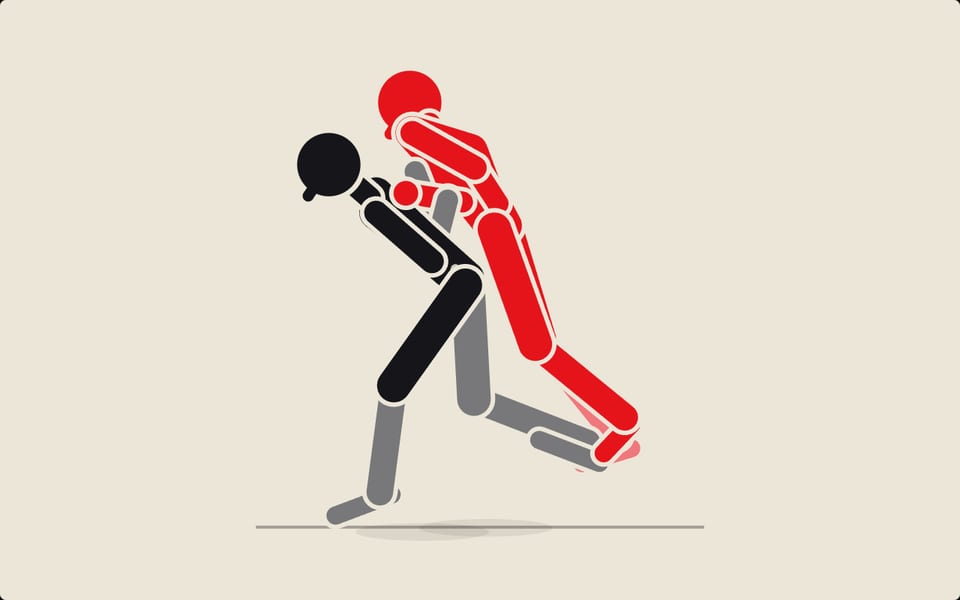
Uchi-mata is judo's inner thigh throw. You open your partner's feet, break their balance forward, turn in and swing your leg up between theirs,…



Sumi-gaeshi is the corner throw. You drop onto your back between your partner's feet, hook the inside of their thigh with the top of your foot and…

The fireman's carry drops under the opponent's arm, takes their thigh and rolls them across your shoulders to the mat. It is fast, scores well when…