隅返Sumi-gaeshi · say “SOO-mee GAH-eh-shee” · “corner reversal”
Also called Corner throw, Corner reversal
Sumi-gaeshi is the corner throw. You drop onto your back between your partner's feet, hook the inside of their thigh with the top of your foot and lift it, and pull them forward over your head. It is a rear sacrifice throw that uses your partner's forward momentum, so it works best when they are leaning forward, either because you pulled them or because they are attacking. That makes it a common counter.
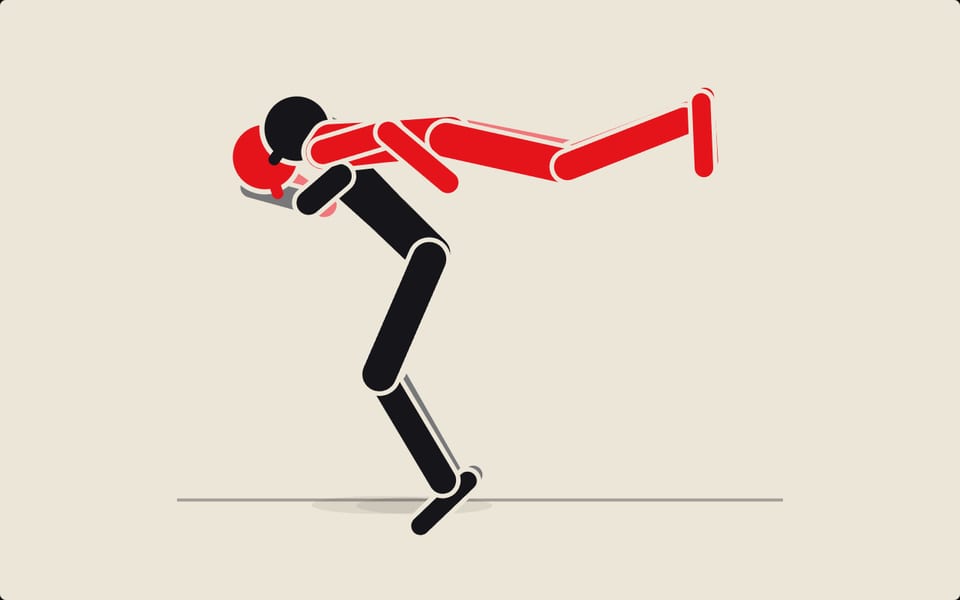
Satori's coaches are filming every technique, full speed and slow motion from two angles. Until it's up, the diagram shows the movement step by step.
How to do it
Start: Take the classic sleeve-and-lapel grip. Stand a step apart in a natural stance. Your partner should be leaning into you or bending forward, for example while they set up a forward throw.
- 1Grip. Hold the sleeve with one hand and the lapel with the other, elbows soft.
- 2Kuzushi. Lift and pull them forward, stepping back with the right foot. When they step their right foot forward past the left, their knees and hips are bent, their feet are apart and their weight is on the toes of both feet.
- 3Tsukuri. Step your left foot in between their feet and lower your hips slightly.
- 4Kake, drop. Fall onto your back right between their feet, supporting your weight on your left foot.
- 5Kake, lift. Put the top of your right foot on the inside of their left thigh and spring it up, lifting the thigh.
- 6Kake, throw. Lift them further with both hands and pull them forward over your head. They rotate in a big circle.
- 7Finish. They land on their back. Keep hold of the sleeve and come up to a hold or to standing.
- Fall between their legs, not behind you.
- Instep under the thigh, never the groin.
- Pull them down and over with both hands as you fall.
- Hold the grips until they have landed.
- Falling behind you instead of between their legs. Fix: step the left foot deep between theirs and drop beside it.
- Putting the foot in the groin. Fix: hook the thigh with the instep, well below the groin.
- Dropping before their balance is broken. Fix: pull and lift first.
- Letting go of the sleeve or lapel. Fix: keep hold so you control the landing.
- Dropping too far away. Fix: step in close before you drop.
Safety: Learn your breakfalls first and throw only onto mats with a trained partner. Hook the thigh with the instep, never the groin, and keep your chin tucked as you fall. Judo Canada's manual forbids sacrifice throws for its U12 group.
When to use it
- As a counter when they commit to a forward throw. Baasankhuu Bavuudorj beat Assunta Scutto's seoi-otoshi attempt this way in a world final.
- When they bend forward or lean into you.
- When you need a score late in the match: Teddy Riner scored his Rio 2016 semi-final waza-ari in the last second with it.
- Lift and pull them forward, then ease off and lift again as they step.
- Wait for a forward attack and drop under it.
- A hold-down. You can follow up with any number of grapples, joint extensions or chokes.
- Getting back to your feet or rolling up with the sleeve still in your hand.
- Stay tall and keep your weight back so you don't hang over the thrower.
- Sprawl your legs back as they drop, so there is no thigh to lift.
- Step back out of the pull and move round them to the ground.
- Keep your posture tall and your hips back when you attack.
- Don't stay bent over at the end of a forward throw attempt.
- Step away from the dropping foot and take the top position.
The physics
Sumi-gaeshi is a sacrifice throw that Sacripanti places among the maximum-arm levers, with the fulcrum made by the friction under your partner's feet.
You sit down under them while pulling their upper body forward and down, and your instep hooks behind their knee or inner thigh and lifts. Your falling weight supplies most of the force, but because it acts steeply downward, the lifting leg and the pull of your arms must steer it so they rotate over you toward the corner. The best moment is when they are bent forward with their weight over their feet, because the upper body is free to keep travelling while the feet stay planted. If they keep their hips back, the pivot under their feet never loads and they simply sit down on you.
Masters and famous moments
Scutto kept attacking with o-uchi-gari and seoi-otoshi while Bavuudorj worked the hips and held the better grips. In the last seconds Bavuudorj met another seoi-otoshi with a tight sumi-gaeshi for ippon and the world title.

Krpálek, who went on to win the gold medal, trailed early in his first match. In the last minute he scored a waza-ari with sumi-gaeshi and won.

It was the second match in a row that Riner had to win by a single waza-ari after the full five minutes. This time it came from sumi-gaeshi, in the last second. He went on to take gold on penalties in the final.
Toma won the bronze medal with an ippon by sumi-gaeshi in 2:16. It was only the second Olympic medal ever won by the United Arab Emirates.
Across the arts
The form in the steps: sleeve and lapel, a drop between their feet and the instep under the inside of the thigh.
You let them commit, then drop under their attack. Bavuudorj's counter to a seoi-otoshi is an example.
The IJF list names hikikomi-gaeshi and tawara-gaeshi beside sumi-gaeshi, tomoe-nage and ura-nage among the rear sacrifice throws.
Lukáš Krpálek lists sumi-gaeshi among his signature throws, and he used it in his first match at Rio 2016 on the way to gold. At Paris 2024 Tato Grigalashvili won an Olympic semi-final with a golden-score sumi-gaeshi waza-ari.
History
Sumi-gaeshi is one of the original forty throws of Jigoro Kano's Gokyo, in the fourth group, and the third of the three rear sacrifice throws in the Nage-no-kata. At the 2024 World Championships, Baasankhuu Bavuudorj won the women's -48 kg final with a counter sumi-gaeshi. At Rio 2016 Teddy Riner won a semi-final with it and Sergiu Toma won a bronze medal with it.
In the rules
Drills
Alone on a mat, practise stepping the left foot in, falling to your back and swinging the right instep up, chin tucked. Ten slow reps each side.
Your partner stands tall. Step in, drop and place the instep under their thigh without lifting. Ten reps each side, holding for a count of two.
With a trained partner who can breakfall, throw at half speed, five reps each side, holding the sleeve through the landing.
Legends known for it

We teach it in Throws. A coach will fix the details you can't see yourself. Join now and book your first class for $20, paid online.
Related techniques
Tomoe-nage is the circle throw. You drop onto your back right in front of your partner, put a foot on their lower belly, and push them up and over…
Ura-nage is judo's back throw. You wrap both arms round your partner from the side, lift them off the mat and fall backward, throwing them in a…
Tani-otoshi is the valley drop. You slide one leg behind your partner's leg or legs, fall to your side, and pull them backward over their heel so…
Seoi-nage is judo's shoulder throw. You turn your back into your partner, tuck an arm under theirs, load them onto your back and tip them forward…
 1985–2000
Kuzushi is breaking your partner's balance so they cannot resist your throw. In judo it is the first of three parts of every throw: kuzushi (break…
Ukemi is the art of falling safely. Judo teaches four breakfalls (rear, side, forward and the forward roll) that spread the impact over your arm,…