浮腰Uki-goshi · say “OO-kee GOH-shee” · “floating hip”
Also called Floating hip throw
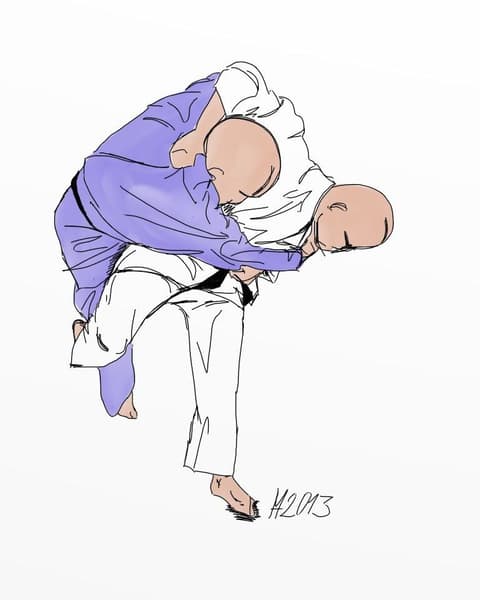
Uki-goshi is the floating hip throw. You reach an arm round your partner's waist, turn in with a shallow hip and twist them around it, without lifting them high. It is shallower than o-goshi and works more by rotation than by lifting, which makes it a good early hip throw and an awkward surprise for a partner who is ready for a deep entry.
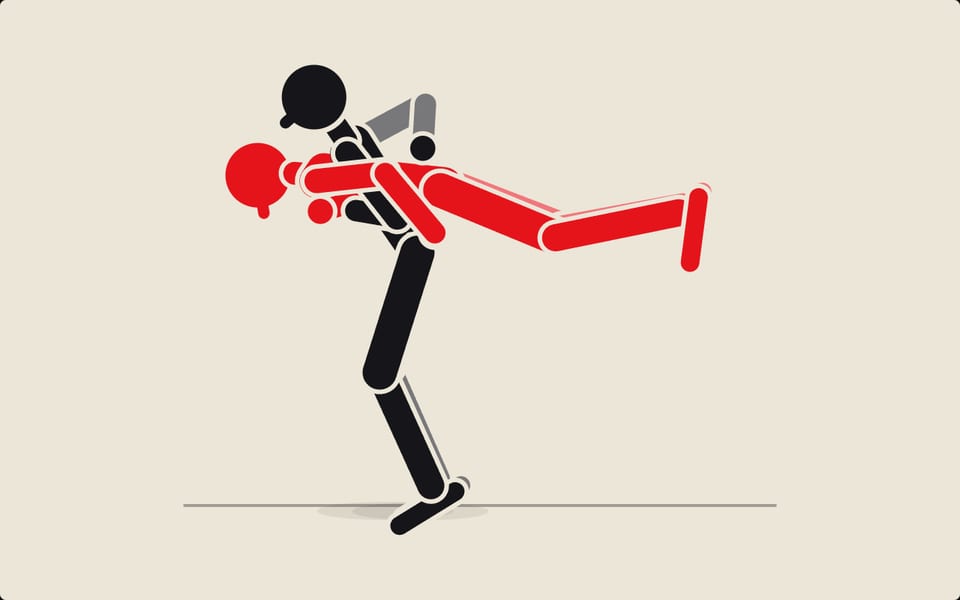
Satori's coaches are filming every technique, full speed and slow motion from two angles. Until it's up, the diagram shows the movement step by step.
How to do it
Start: Take a right-handed grip: left hand on their right sleeve, right hand on their left lapel. Stand a step apart in a natural stance. Your partner should be upright and starting to step their right foot back, so their weight is about to come toward you.
- 1Grip. Hold the sleeve with your left hand and the lapel with your right, elbows loose.
- 2Kuzushi. Push them back a step or two, then ease off as they start to step back with the right foot. Lift and pull with both hands. They rise onto their toes, straight ahead or toward their right front corner.
- 3Tsukuri, feet. Step your right foot inside their right foot and pivot, then step your left foot back and round, outside their left foot. You end side-on, right leg straight and left leg slightly bent.
- 4Tsukuri, arm. Lower your right shoulder and slide your right arm through their left armpit, along the back of their belt, to hold the back or side of their waist.
- 5Tsukuri, contact. Pull with your left hand and your right arm together until the front of their hip meets the side of your hip and their body is tight against yours.
- 6Kake. Lean in and twist to the left around your right hip, pulling their waist into you. They swing in a wide circle around your hip instead of going up over your back.
- 7Finish. Hold the sleeve until they land, then stand tall and control them.
- It is a twist around your hip, not a lift.
- Reach deep round the waist, then hold them tight.
- Stay side-on. If you turn your back fully to them, it is turning into o-goshi.
- Coaches differ on the forward bend: the IJF describes the throw done without bending forward, while the Kodokan text allows a slight lean to bring them tight. Follow your coach.
- Turning in too deep and backing into them. Fix: stay side-on with a shallow hip.
- Holding only the clothing, not the waist. Fix: reach round until your hand is on the far side of their waist.
- Throwing with the arms. Fix: pull with both hands and twist from your hip.
- Leaning away, so there is a gap. Fix: bend slightly at the waist and pull their belly to your side.
- Letting go of the sleeve. Fix: keep it so they land on their back.
Safety: Learn breakfalls first and throw only onto mats with a trained partner. Keep hold of the sleeve so they land on their back.
When to use it
- When they step back and stand upright, which puts their weight on their toes.
- Against a heavier partner you can't lift onto your back: the twist needs less strength than a deep hip throw.
- As a quick, shallow surprise when they expect a deeper hip throw.
- Push them back lightly, then turn in as they push forward against you. Jigoro Kano's own advice, recorded in 1927, was to push the upper body back as you enter so they react by coming forward.
- Step back and pull so they follow, then ease off and enter as they start to step back.
- O-goshi: if they resist the twist and you are already close, turn deeper and lift them onto your hips. The Kodokan says a lifting finish makes it an o-goshi.
- A hold-down such as kesa-gatame if they land on their side.
- Hip block: drop your hips and push your belly forward so they can't bring their hip against yours.
- Ura-nage, lifting them as they turn in.
- Step back out of the turn and throw them with an inside reap as they over-rotate.
- Keep your hips back and your weight over your heels so you can't be pulled tight.
- Clamp your arm to your side before it is held, and turn to face them.
- Push on their hip with your free hand as they enter.
The physics
Uki-goshi is a variable-arm lever in which your hip is a pivot rather than a platform. You put the side of your hip across the front of your partner's hips and turn, and they rotate around it, which is why they seem to float instead of being lifted.
The turning of your trunk, with your arm around their back and your sleeve pull, supplies the torque; your legs hardly straighten because their centre of mass barely needs to rise. Keeping them pressed tight to your side keeps their mass close to your turning axis, so the same turning effort spins the pair faster. It works best when their weight is already coming forward, because the pivot only has to redirect movement they have started.
Masters and famous moments
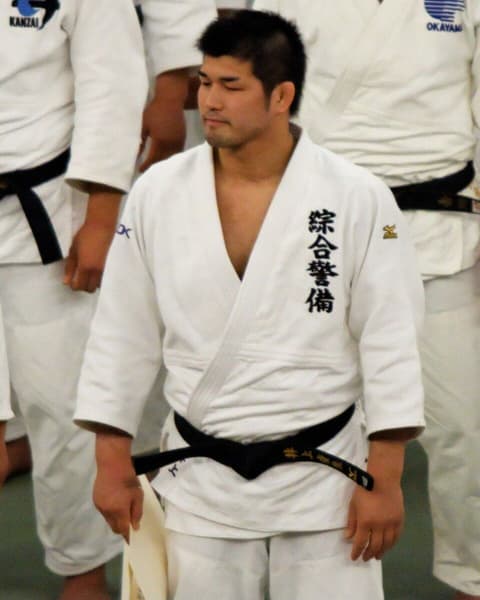
Canada's Elnahas ended his second-round match against Serbia's Kukolj with an uki-goshi for ippon at 3:23, in the last minute of the bout.
Australia's Haecker needed under a minute to beat Ukraine's Antipina: uki-goshi for ippon at 0:54. It shows how quickly a shallow hip throw can finish a match when the timing is right.
China's Xu scored ippon over Kazakhstan's Berlikash with uki-goshi at 2:37, one of the quick early-round finishes that keeps this old throw alive.
Across the arts
The form in the steps: arm through the armpit, hold at the back or side of the waist, and a twist around your right hip. The Kodokan says that if you lift them onto the back of your hip and throw from there, the technique has become o-goshi.
The entry the Kodokan teaches: when they step back with the right foot, you step inside it and go in. It is the same timing as o-goshi and tsurikomi-goshi.
It shows up as a quick, shallow surprise rather than a main weapon. The three examples below are ippons scored in early rounds of the World Championships in 2022 and 2024.
History
Uki-goshi is in the first group of the Gokyo and is one of the three hip throws of the Nage-no-kata. It was a favourite throw of Jigoro Kano himself and used to be drilled a great deal in traditional dojos. A Kodokan magazine article from 1927, quoted on judo.how, records Kano's advice on entering it.
In the rules
Drills
Practise the foot pattern alone: right foot inside, pivot, left foot back and round, stopping side-on with the right arm reaching round an imaginary waist. Ten slow reps each side.
Your partner stands tall. Fit in until their hip touches yours and hold for a count of two. Ten reps each side, then add a step back and pull before each entry.
Throw at half speed onto mats with a trained partner, five reps each side.
We teach it in Throws. A coach will fix the details you can't see yourself. Join now and book your first class for $20, paid online.
Related techniques
O-goshi is judo's major hip throw. You turn in with your hips lower than your partner's, wrap an arm around their back, load them onto your hips…


Koshi-guruma is the hip wheel. You turn in with your arm round your partner's neck or holding their collar, push your hip out and pull them over it…
Harai-goshi is judo's sweeping hip throw. You pull your partner onto their toes, turn in with your hip against theirs and sweep your straight leg…


Tsurikomi-goshi is the lift-pull hip throw. You drop your hips to the level of your partner's thighs, then rise again while your lapel-side arm…
Kuzushi is breaking your partner's balance so they cannot resist your throw. In judo it is the first of three parts of every throw: kuzushi (break…
Uchi-mata is judo's inner thigh throw. You open your partner's feet, break their balance forward, turn in and swing your leg up between theirs,…