釣込腰Tsurikomi-goshi · say “tsoo-ree-KOH-mee GOH-shee” · “lift-pull hip”
Also called Lift-pull hip throw, Lifting and pulling hip throw
Tsurikomi-goshi is the lift-pull hip throw. You drop your hips to the level of your partner's thighs, then rise again while your lapel-side arm lifts and your sleeve hand pulls, so they are levered over your hips. Unlike o-goshi, you don't wrap their waist. You keep the collar or lapel hold, and your upper arm lifts up under their armpit as your hips scoop them up.
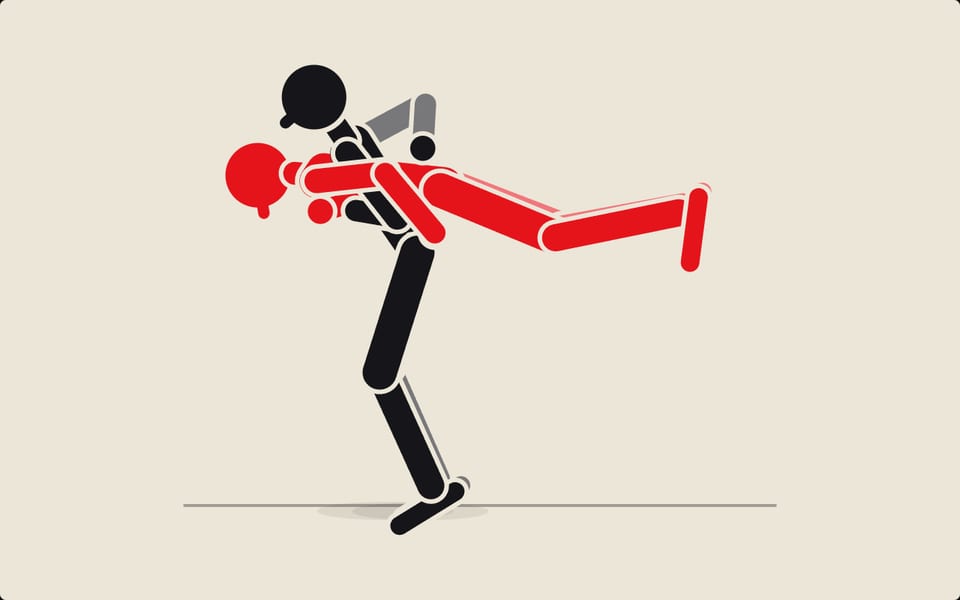
Satori's coaches are filming every technique, full speed and slow motion from two angles. Until it's up, the diagram shows the movement step by step.
How to do it
Start: Take the classic right-handed grip with a firm lapel or collar hold in your right hand and their right sleeve in your left. Stand a step apart in a natural stance. Your partner should be upright and starting to step their right foot back.
- 1Grip. Hold the sleeve with your left hand and a high lapel or collar with your right.
- 2Kuzushi. Step back pulling them forward, then stop and press down lightly. When they lean forward and begin to step back with the right foot, ease the pull and push a little with your left hand so they straighten. As their right foot passes behind the left, step your right foot in beside the tip of theirs. Lift and pull with your right hand and pull up with your left. They rise onto their toes and can't put weight on the right foot.
- 3Tsukuri, feet. Lower your body and pivot on the ball of your right foot. Step your left foot back inside their left foot, so your back faces them.
- 4Tsukuri, arm. Press your right upper arm up into their left armpit and chest. Pull your left hand toward the right side of your chest, so their chest and belly come tight against the right side of your back.
- 5Tsukuri, hips. Bend both knees and lower your hips so the back of your waist sits against the front of their belly. Your body is parallel to theirs and tight against it, not sticking out behind you.
- 6Kake. Straighten your knees and scoop them up with the back of your waist while lifting and pulling with both hands. Twist to the left. They go over in a big circle and land in front of you.
- 7Finish. Hold the sleeve until they land, then control them or move into a hold.
- Lower first, then lift.
- Your lapel-side arm lifts. It doesn't wrap the waist.
- Their belly sits on the back of your waist, tight.
- Pull the sleeve toward the right side of your chest.
- Sticking your hips out behind you. Fix: keep your body parallel to theirs and tight against it.
- Lifting with the hands only. Fix: lower first, then straighten the knees and scoop them up with the back of your waist.
- Going in too late, after their weight has settled back on the right foot. Fix: move as the right foot passes behind the left.
- A gap between your back and their belly. Fix: step deep and pull with the sleeve hand toward your chest.
- Letting go of the sleeve. Fix: keep it so they land on their back.
Safety: Learn breakfalls first and throw only onto mats with a trained partner. Keep the sleeve so they land on their back, and don't lift a resisting or much heavier partner.
When to use it
- When they step back with the right foot. It is the same timing as o-goshi and uki-goshi.
- When they guard their waist against o-goshi: you don't need the waist wrap.
- When you have a firm collar or lapel grip and a live sleeve.
- The Kodokan sequence: pull them forward, stop and press down, ease and push lightly so they straighten, then go in as the right foot steps back.
- Start for o-goshi and switch to the lapel lift if they turn their waist away.
- A hold-down such as kesa-gatame if they land on their side.
- O-goshi or uki-goshi, which share the same entry, if they block the lift.
- Hip block: drop your hips and push your belly forward so you can't be scooped up.
- Step back out of the turn and throw them with an inside reap as they over-rotate.
- Ura-nage, lifting them as they turn in. The Kodokan teaches it as an answer to a hip throw.
- Clamp your right arm to your side before their upper arm gets into your armpit.
- Keep your weight over both feet so you can't be lifted onto your toes.
- Turn to face them and push on their hip as they enter.
The physics
Tsurikomi-goshi is a variable-arm lever built on a lift-pull. Your lapel and sleeve hands draw your partner up and forward onto their toes, which raises their centre of mass and shrinks their base to the balls of the feet.
Your hips then drop well below their belt line to become the pivot; moving the fulcrum down their body lengthens the lever arm to your hands and lowers the force you need, which Sacripanti gives as the reason competitors lower the fulcrum. Your knees bend to get under them and then straighten while your trunk turns, so the legs, not the arms, drive the throw. If the lift stops the moment your hips arrive, their heels settle back down and the lever loses its load.
Masters and famous moments
Bekauri took the lead with a tsurikomi-goshi waza-ari 1:30 into the final. That single score was enough: he kept the lead to the final bell and won the Olympic gold medal for Georgia.
Grigalashvili, who went on to win the world title, beat France's Djalo in the second round by ippon with tsurikomi-goshi at 1:41.
Korea's Kim needed only 1:11 to beat Ukraine's Iadov in the quarter-final, finishing with tsurikomi-goshi for ippon.
Across the arts
The form in the steps: lapel or collar hand lifts over the shoulder, sleeve hand pulls, and the hips scoop them up.
The IJF calls this a variant in which your right hand holds their left outer sleeve or cuff instead of the lapel. It is a separate throw with its own page.
A neighbouring throw the Kodokan keeps separate. You grip the belt at the back and lift them onto your waist, where tsurikomi-goshi keeps the collar or lapel hold.
The throw hasn't changed, and it still scores at the top. Lasha Bekauri won the Tokyo Olympic final with a waza-ari from it, then held the lead to the bell, and Tato Grigalashvili scored an ippon with it on his way to the 2022 world title.
History
Tsurikomi-goshi is one of the original forty throws of Jigoro Kano's Gokyo, in the second group, and the third hip throw of the Nage-no-kata. It also appears in the Danzan-ryu list of 20 techniques. The Kodokan separates it from o-goshi and tsuri-goshi by the grip: a collar or lapel hold with the upper arm lifting under the armpit for tsurikomi-goshi, an arm round the waist for o-goshi and a belt grip for tsuri-goshi.
In the rules
Drills
Practise the foot pattern and the knee bend alone: step in, pivot, drop your hips, then rise while turning. Ten slow reps each side, then ten quick ones.
Your partner stands tall. Step in and load them onto the back of your waist without lifting. Ten fast reps each side.
Throw at half speed with a partner who can breakfall, five reps each side, holding the sleeve through the landing.
We teach it in Throws. A coach will fix the details you can't see yourself. Join now and book your first class for $20, paid online.
Related techniques
O-goshi is judo's major hip throw. You turn in with your hips lower than your partner's, wrap an arm around their back, load them onto your hips…


Uki-goshi is the floating hip throw. You reach an arm round your partner's waist, turn in with a shallow hip and twist them around it, without…
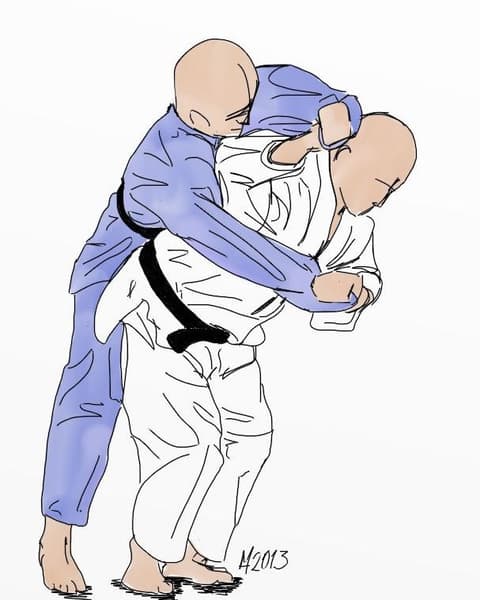
Sode-tsurikomi-goshi is a hip throw from sleeve grips. You stretch one of your partner's arms up and forward by the sleeve, turn in under it and…
 2005–2019
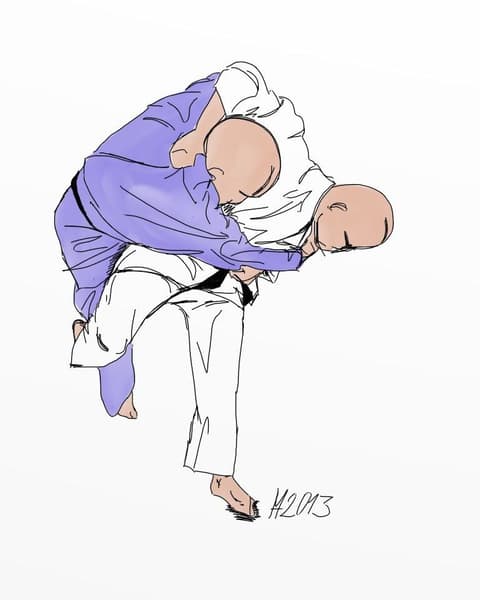
Harai-goshi is judo's sweeping hip throw. You pull your partner onto their toes, turn in with your hip against theirs and sweep your straight leg…


Koshi-guruma is the hip wheel. You turn in with your arm round your partner's neck or holding their collar, push your hip out and pull them over it…
Kuzushi is breaking your partner's balance so they cannot resist your throw. In judo it is the first of three parts of every throw: kuzushi (break…