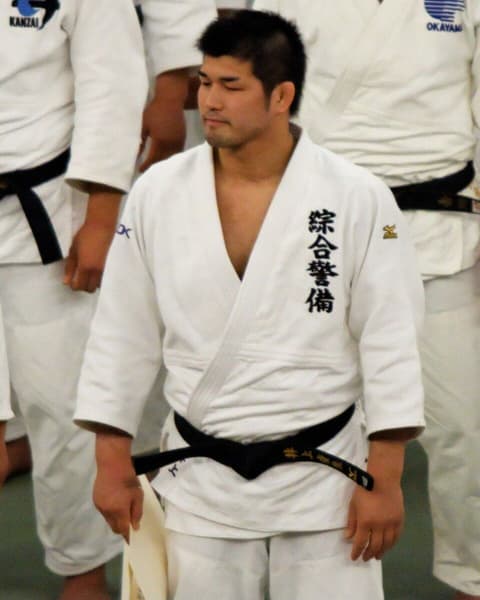
谷落Tani-otoshi · say “TAH-nee oh-TOH-shee” · “valley drop”
Also called Valley drop
Tani-otoshi is the valley drop. You slide one leg behind your partner's leg or legs, fall to your side, and pull them backward over their heel so they land on their back. It is a side sacrifice throw (yoko-sutemi-waza). It works when you have led your partner onto one leg, and you slide your leg behind theirs without hooking it.
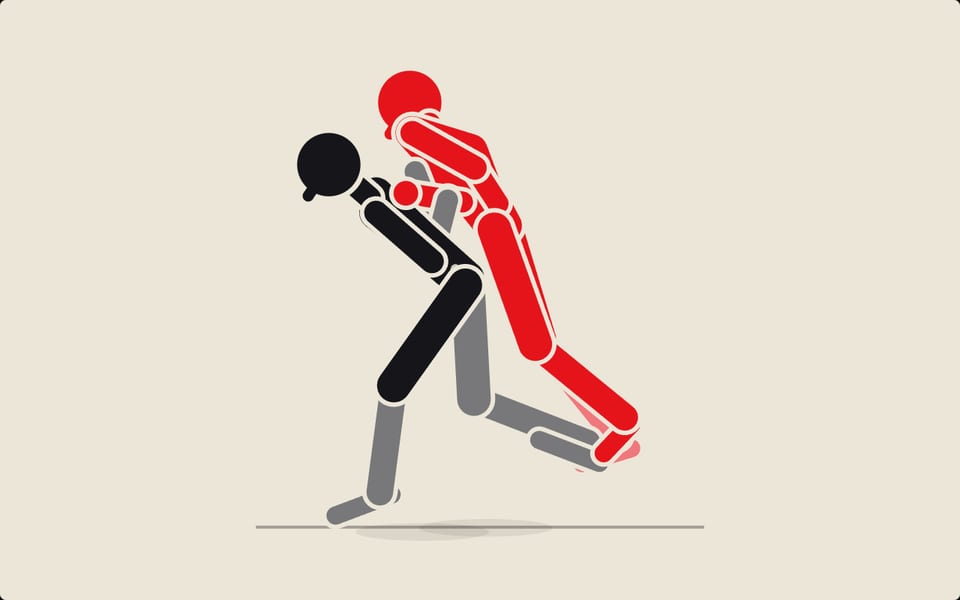
Satori's coaches are filming every technique, full speed and slow motion from two angles. Until it's up, the diagram shows the movement step by step.
How to do it
Start: Take the classic sleeve-and-lapel grip. Stand a step apart in a natural stance. Your partner should be pushing back against you, so their weight is about to move onto one foot.
- 1Grip. Sleeve in one hand, lapel in the other, elbows soft.
- 2Kuzushi. Press them down lightly and wait for their reaction. When they push back and step forward with the left foot, change your right hand to a circular lift and pull, and pull your left hand toward the left side of your chest. They are pulled toward their right rear corner, and their left foot comes off the mat.
- 3Tsukuri, feet. Draw your right foot up close to the tip of their right foot and support yourself on the right leg.
- 4Tsukuri, leg. Slide your left leg in behind their right leg, or behind both legs. Keep it separate from theirs: slide it, don't hook it.
- 5Kake. Drop down onto your left side while pushing with the right hand and pulling down with the left. They are thrown backward in a large rotation around their right heel.
- 6Finish. They land on their back and you land on your side. Keep hold of the sleeve and come up to a hold or to standing.
- Get them onto one leg first.
- Slide the leg behind theirs. Never hook it.
- Drop to your left side, pushing with the right hand and pulling down with the left.
- Rotate them around their heel.
- Hooking their leg and falling backward onto them. Fix: slide the leg down behind theirs and fall to your side.
- Starting before they are on one leg. Fix: wait for the push-back and the step.
- Falling straight back instead of to the side. Fix: drop onto your left side.
- Letting go with the pulling hand. Fix: keep pulling down to the end of the throw.
- Dropping too far away. Fix: draw your right foot up close first.
Safety: Learn your breakfalls first and throw only onto mats with a trained partner. Never hook their leg and fall back onto them: that is a banned throw, and it is dangerous for both of you. Judo Canada's manual forbids tani-otoshi for its U12 and U14 groups.
When to use it
- When they step forward onto one leg after you press and they push back. This is the Kodokan's own timing.
- As a counter when they attack and commit their weight to one leg. Temur Rakhimov scored his Paris Olympic bronze-medal waza-ari that way.
- Press them down lightly, then use their push-back (the Kodokan sequence).
- Lift their weight onto one foot with a circular pull of the lapel hand.
- A hold-down. Haruka Tachimoto followed her tani-otoshi with a pin for ippon in the Rio 2016 final.
- Getting back to your feet quickly if the throw only scores a waza-ari.
- Stay on both feet. The throw depends on leading you onto one leg.
- Drop your weight and sprawl your legs back so their leg can't slide behind yours.
- Step out of the circle with the free foot as they slide in.
- Keep your weight over both feet and avoid standing on one leg while you grip.
- Keep your hips back and your chest up so you can't be pulled over your heel.
- Turn your hips toward them as they slide in.
The physics
Tani-otoshi is a sacrifice throw from Sacripanti's maximum-arm lever group. Your leg slides behind both of your partner's heels and blocks them, putting the fulcrum at their ankles.
You then drop to your side behind them and drive their upper body backward and down along the line of your leg, so they rotate around the blocked ankles on a lever as long as their whole body. Your falling weight provides most of the force and your arms steer it. Because the lever is so long, little force is needed once their weight has moved back onto their heels, which is why it suits moments when they lean or step back.
Masters and famous moments
Ranked only 12th, Tachimoto beat Colombia's three-time world champion Alvear, who had the crowd on her side. A tani-otoshi gave her the waza-ari, and she held Alvear down for the 20 seconds needed to turn it into ippon at 2:19.
Nagase kept his Olympic title with a tani-otoshi ippon at 2:48, against Grigalashvili, who had come into the Games as the favourite.
Khakhaleishvili dominated the final, putting Japan's Ogawa down twice with tani-otoshi. The two waza-ari added up to ippon after just 1:04.
Uta Abe, the defending champion, led with a waza-ari from uchi-mata at 2:14. Keldiyorova answered with a tani-otoshi for ippon at 3:04, and went on to win the gold medal.
Across the arts
The form in the steps: you drop with the left leg separate from their right leg, so it doesn't hook.
The IJF describes sliding the left foot past the outside of their right foot or behind both feet. The Kodokan says that if they answer with the left foot stepped back, you slide the leg in deep behind both legs and they are thrown straight back onto the spot.
It scores at the top. Takanori Nagase won his second Olympic gold with a tani-otoshi ippon in Paris, and Diyora Keldiyorova beat the defending champion Uta Abe with one.
History
Tani-otoshi is one of the original forty throws of Jigoro Kano's Gokyo, in the fourth group. The Kodokan classes it as a side sacrifice throw (yoko-sutemi-waza). Olympic champions have won finals with it from 1992 to 2024: Davit Khakhaleishvili in 1992, Haruka Tachimoto in 2016 and Takanori Nagase in 2024.
In the rules
Drills
Alone on a mat, practise drawing the right foot up, sliding the left leg back and dropping to your left side with your arms pulling. Ten slow reps each side, chin tucked.
Your partner stands tall. Press, let them push back, then step in and slide your leg behind theirs without dropping. Ten reps each side.
With a trained partner who can breakfall, throw at half speed, five reps each side, keeping the sleeve.
We teach it in Throws. A coach will fix the details you can't see yourself. Join now and book your first class for $20, paid online.
Related techniques
Sumi-gaeshi is the corner throw. You drop onto your back between your partner's feet, hook the inside of their thigh with the top of your foot and…

Tomoe-nage is the circle throw. You drop onto your back right in front of your partner, put a foot on their lower belly, and push them up and over…
Ura-nage is judo's back throw. You wrap both arms round your partner from the side, lift them off the mat and fall backward, throwing them in a…
Kuzushi is breaking your partner's balance so they cannot resist your throw. In judo it is the first of three parts of every throw: kuzushi (break…
Ukemi is the art of falling safely. Judo teaches four breakfalls (rear, side, forward and the forward roll) that spread the impact over your arm,…
Uchi-mata is judo's inner thigh throw. You open your partner's feet, break their balance forward, turn in and swing your leg up between theirs,…