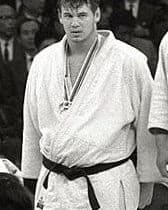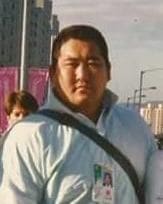
Hitoshi Saito
Beat injury and pressure for a second Olympic gold
- Born
- January 2, 1961, Aomori, Japan
- Died
- January 20, 2015 (aged 54)
- Nationality
 Japan
Japan- Height
- 180 cm (5′11″)
- Stance
- Left
- Style
- Heavyweight ground specialist
- Weight
- +95 kg, Open
- Active
- 1980–1988
The medals
2 Olympic heavyweight golds, 1983 world open title
The story
itoshi Saito spent his early career in the shadow of his friend and rival Yasuhiro Yamashita, losing to him in seven finals. He still won the 1983 world open title and the 1984 Olympic heavyweight gold in Los Angeles, beating France's Angelo Parisi. At the 1985 Worlds, Korea's Cho Yong-chul dislocated his elbow with a standing armlock, and a knee injury followed, yet he came back to win the 1988 All-Japan Championships. In Seoul every other Japanese judoka had missed out on gold before he fought; he won his early bouts on the ground, beat Cho in the semi-final and Henry Stöhr in the final, becoming Japan's first double Olympic heavyweight champion. He later coached the national team and died of cancer in 2015, aged 54.
- Olympic champion, +95 kg (1984, 1988)
- World champion, open category (1983)
- Asian Games champion, +95 kg (1986)
- All-Japan champion (1988)
- IJF Hall of Fame (2018, posthumous)
- Order of the Rising Sun, Gold Rays with Rosette (posthumous)
- Kodokan 9th dan (posthumous)
Defining matches
- 1984WINvs Angelo Parisi (Los Angeles Olympic +95 kg final)
- 1985LOSSvs Yasuhiro Yamashita (All-Japan final, Yamashita's last match)
- 1985LOSSvs Cho Yong-chul (World +95 kg final; elbow dislocated by a standing armlock)
- 1988WINvs Cho Yong-chul (Seoul Olympic semi-final, decision)
- 1988WINvs Henry Stöhr (Seoul Olympic final, second heavyweight gold)
Saito won his early Seoul bouts on the mat: when a big opponent turns to their front or scrambles after a failed throw, be first to the hold instead of waiting for the stand-up. He also trained specifically to last through ten-minute finals, so treat conditioning as part of your technique.